





Record High-Pressure Cells
Lately, a high-pressure cell typical of summer compresses the air in the central-east of North America and in parts of Europe, causing temperatures that are unusually high for the season. This phenomenon isn’t an isolated event but is occurring more frequently, affecting various and extensive geographical areas. For instance, between late spring and early summer, we witnessed extraordinary heatwaves in China and Japan. However, winter is also of concern.
It has recently emerged that in the southern hemisphere, currently in the height of winter, an unprecedented heatwave has occurred. Following various heat surges recorded in Australia and Argentina, to the extent that summer-like temperatures were noted in Buenos Aires in the midst of winter, there was a peak of 45 degrees Celsius in Bolivia. This is the highest value ever recorded during winter in the southern hemisphere, even including the scorching Australian deserts.
Heat Storms
These heatwaves are caused by “bombs” of warm air compressing the atmosphere at lower layers, superheating it. These phenomena are detected through specific meteorological instruments. The growing concern among scientists is that, in the future, these high-pressure systems, known as “domes” or “bell”, may become even more intense and compress the lower atmospheric layers with greater force, giving rise to heatwaves with temperatures currently unimaginable.
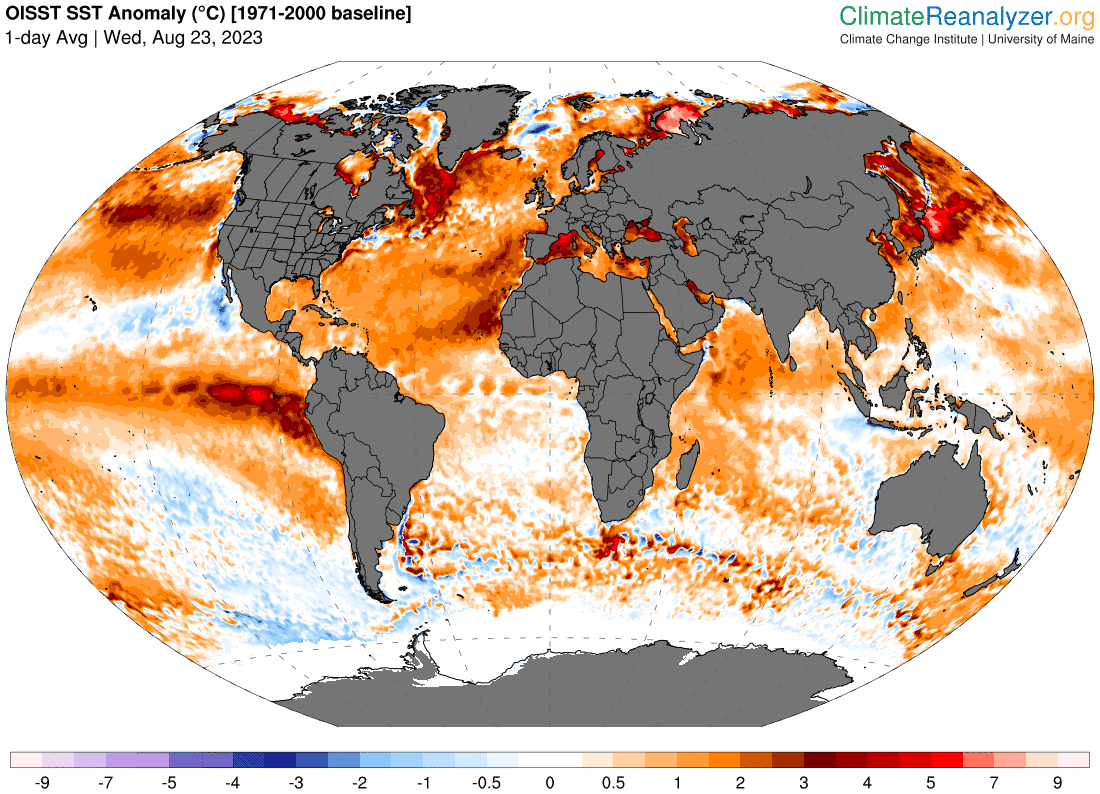
The alternation of climatic anomalies leads to the warming of the oceans which, unlike land masses, cool down much slower during the cold season. This disrupts the typical climate of the colder months, with consequences that are hard to predict, though various hypotheses can be proposed.
Oceans with Record Temperatures
The oceans have never been this warm, reaching 21 degrees Celsius. Scientists claim, “We have never seen anything like this.” On August 1st, a record for the average surface temperature was set. The Mediterranean appears to be the sea warming the fastest.
On Tuesday, August 1st, the global average temperature of the ocean surface, spanning latitudes 60° North to 60° South, touched 21 degrees (20.96°C, to be precise). This is the highest temperature ever recorded since precise analyses were introduced: the previous record was on March 29th, 2016, with 20.95°C. In June, scientists reported temperature anomalies near the coasts of Great Britain and Ireland. Satellite instruments and ocean buoys detected a rise in surface water temperatures of 4-5 degrees (even more in some areas) compared to the seasonal average for those regions. The experts, concerned, stated, “We’ve never seen anything like this,” ranking the marine heatwave at level 4 (out of a maximum of 5).
The data is extraordinary. Usually, the highest marine surface temperatures are recorded in spring; then, a decrease occurs, followed by a slight summer rise that, however, doesn’t reach spring levels. According to a 2022 study, oceans have absorbed a massive amount of heat within the first 2,000 meters deep, largely offsetting the global warming caused by human activities since the industrial revolution.
North Atlantic
When considering only the North Atlantic, the measurements become even more alarming. Here, the difference from the thirty-year averages is even more pronounced. A recent study showed that Atlantic warming is unparalleled in the last 2,900 years. Considering that the record for daily global average temperature was set on July 7th at 17.20°C (and that on July 3rd, for the first time in history, the 17°C threshold was exceeded), it’s understood why climatologists believe 2023 might be the hottest year ever recorded. The rising ocean temperatures heavily impact marine ecosystems. Among the various related issues, we highlight three: the progressive acidification of waters, the increase in energy available for waves, and the rise in sea levels. The latter phenomenon doesn’t solely depend on the melting of continental glaciers (like those in Greenland, Antarctica, the Alps, Himalayas, and Andes) but also from the fact that water, when heated, expands.
Warming Waters of the Mediterranean Sea
Regarding seas, the Mediterranean is the one warming the fastest. On July 24th, 2023, its waters reached a temperature of 28.71°C, surpassing the previous record of 28.25°C set on August 23rd, 2003.”