With the beginning of January 2025, the weather in Europe and Italy will undergo a decisive turn.
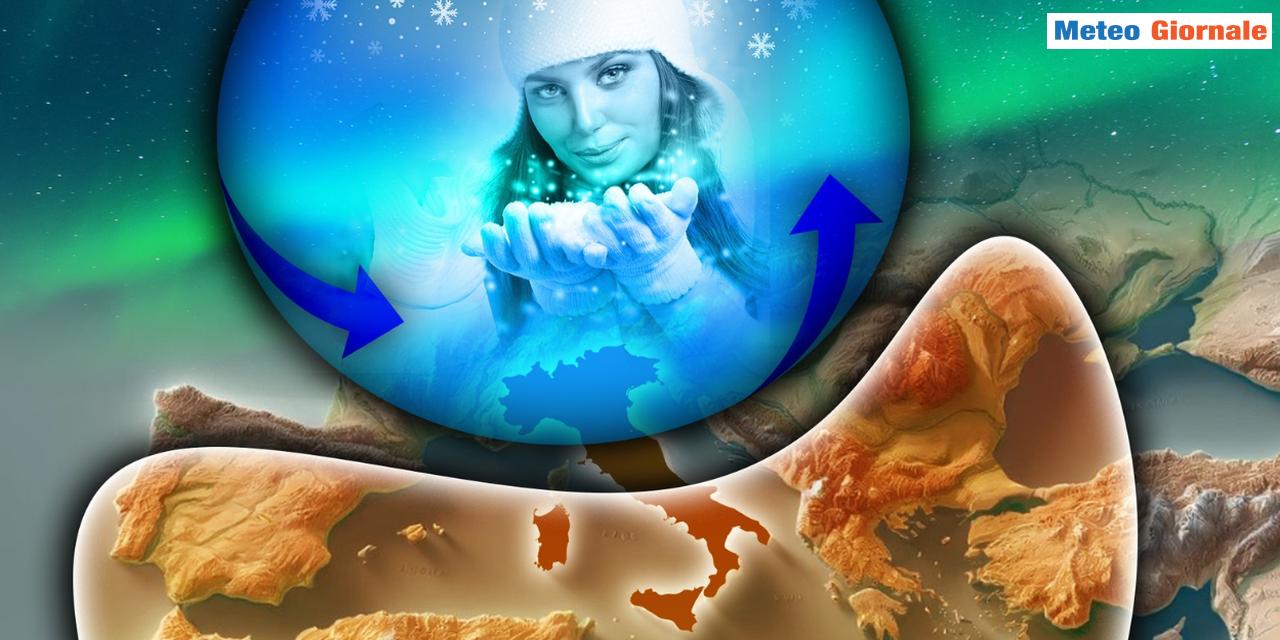
After a period of stability guaranteed by a compact polar vortex, a radical change is expected: the polar vortex will split in two, initiating a phase of intense cold and snow in many regions of the continent, including some areas of Italy.
Stable end of December thanks to the compact polar vortex
The strengthening of the polar vortex, which occurred around Christmas, has kept high pressure over the lower latitudes, providing stable weather over much of the Mediterranean and central Europe.
This setup has blocked the flow of disturbances and cold air masses, allowing for clear days and relatively mild temperatures.
However, this situation is set to change with the arrival of January, when the polar vortex will be attacked on multiple fronts by high pressures.
The push of high pressure towards the North Pole and North America will destabilize the vortex, triggering a split that will have repercussions across the continent.
The polar vortex splits: the consequences
With the polar vortex split in two, contrasting weather conditions will be created.
On one side, eastern Siberia and North America will see stable conditions; on the other, central-northern Europe and Russia will be invaded by polar cold and disturbances.
The result will be a reservoir of icy air settling over the old continent, generating rigid temperatures and low-altitude snow.
Italy and the January cold
Italy will also be involved in this dynamic, although with varying modes depending on the regions:
- Northeast: around Epiphany, snowfalls could occur down to low altitudes, especially in the alpine and foothill areas.
The polar cold arriving from central Europe will find fertile ground to bring significant phenomena. - Center-South: subsequently, the cold could push southward, accompanied by further disturbances that could bring snow to the Apennine regions and, in some cases, down to the hills.
- Northwest: in this phase, the mild recall coming from the Atlantic could limit snowfalls, bringing more substantial precipitation to the mid-altitudes.
Uncertain dynamics, but winter in great shape
Although it is still early to precisely define the trajectories of the disturbances, the weather evolution for January appears clear: the stable period at the end of December will give way to a much more dynamic phase, characterized by cold, snow, and a winter that promises to make itself felt in a significant way.
The polar cold waves could intensify by mid-month, bringing more rigid winter conditions over much of Europe and Italy.
So, let’s prepare for a January that could be remembered as one of the most wintry months in recent years.
 Follow our feed