The high pressure will keep us company for a few more days, not only in Italy but across all of Central-Southern Europe, thanks to a rather compact polar vortex.
Its recovery was entirely physiological right after Christmas, following several weeks of strong weather dynamics that had allowed the arrival of various waves of bad weather in Italy and many other countries in the temperate zone of our hemisphere. However, this recovery of the polar vortex could be quite temporary.
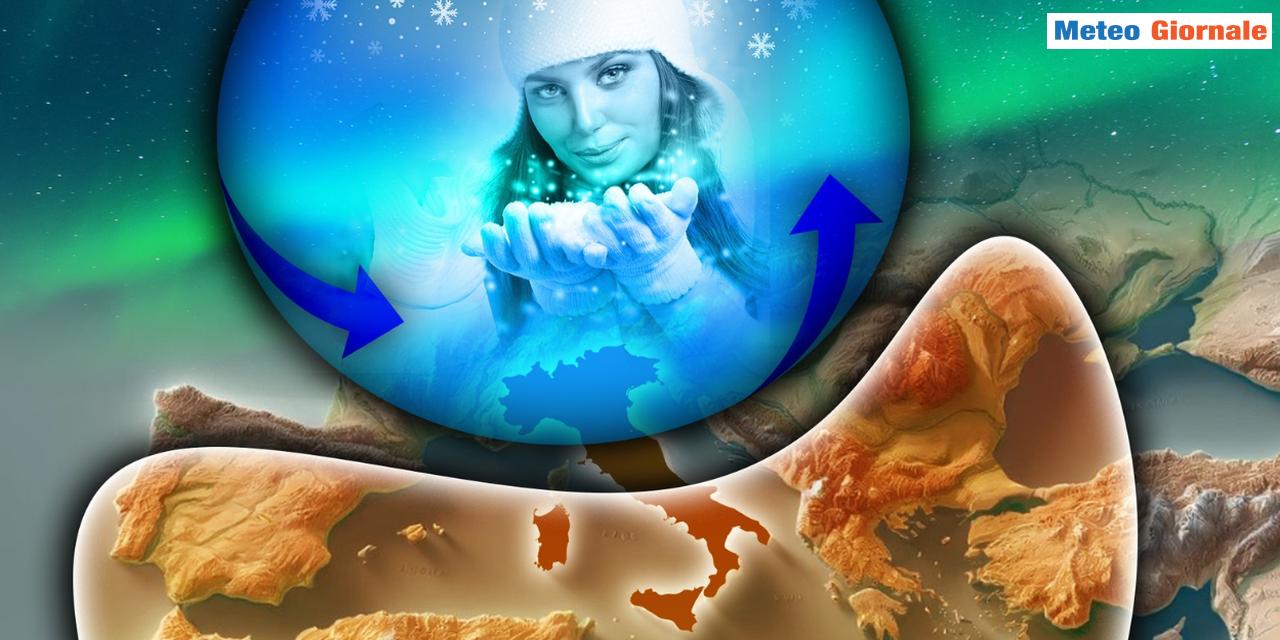
During the first week of January, the polar vortex could face an attack from the three main planetary anticyclonic waves, namely the Siberian anticyclone, the Aleutian anticyclone, and the Azores anticyclone.
The combined attack of these three anticyclones towards the North Pole could put the polar vortex in serious crisis, forcing it to pour its cold towards the lower latitudes.
A twist after Epiphany
The real twist could come right after Epiphany, when a lobe of the polar vortex could literally plunge into Central-Eastern Europe, causing a sharp drop in temperatures and the arrival of snowfalls over vast territories, down to low altitudes.
Between January 7 and 10, a massive reservoir of cold air could develop over Eastern Europe, further challenging the polar vortex.
What a cold reservoir forming!
The presence of this cold wall over Eastern Europe and Scandinavia could force the Azores anticyclone to move even further north, reaching polar latitudes between Greenland, the Norwegian Sea, and the Arctic Ocean.
In this way, the cold area could pour over both Central Europe and the Mediterranean, leading to the arrival of several waves of cold with potentially very low altitude or plain snowfalls along our peninsula. Between the first and second decade of January, winter could roar again, this time with particularly intense cold waves, which could bring snowfalls to very low altitudes or plains in Italy.
It will be necessary to wait a few more days to have a clearer weather picture of the situation, especially regarding the strength of the Azores anticyclone in the Atlantic, on which the descent of the cold into the Mediterranean will depend.
 Follow our feed