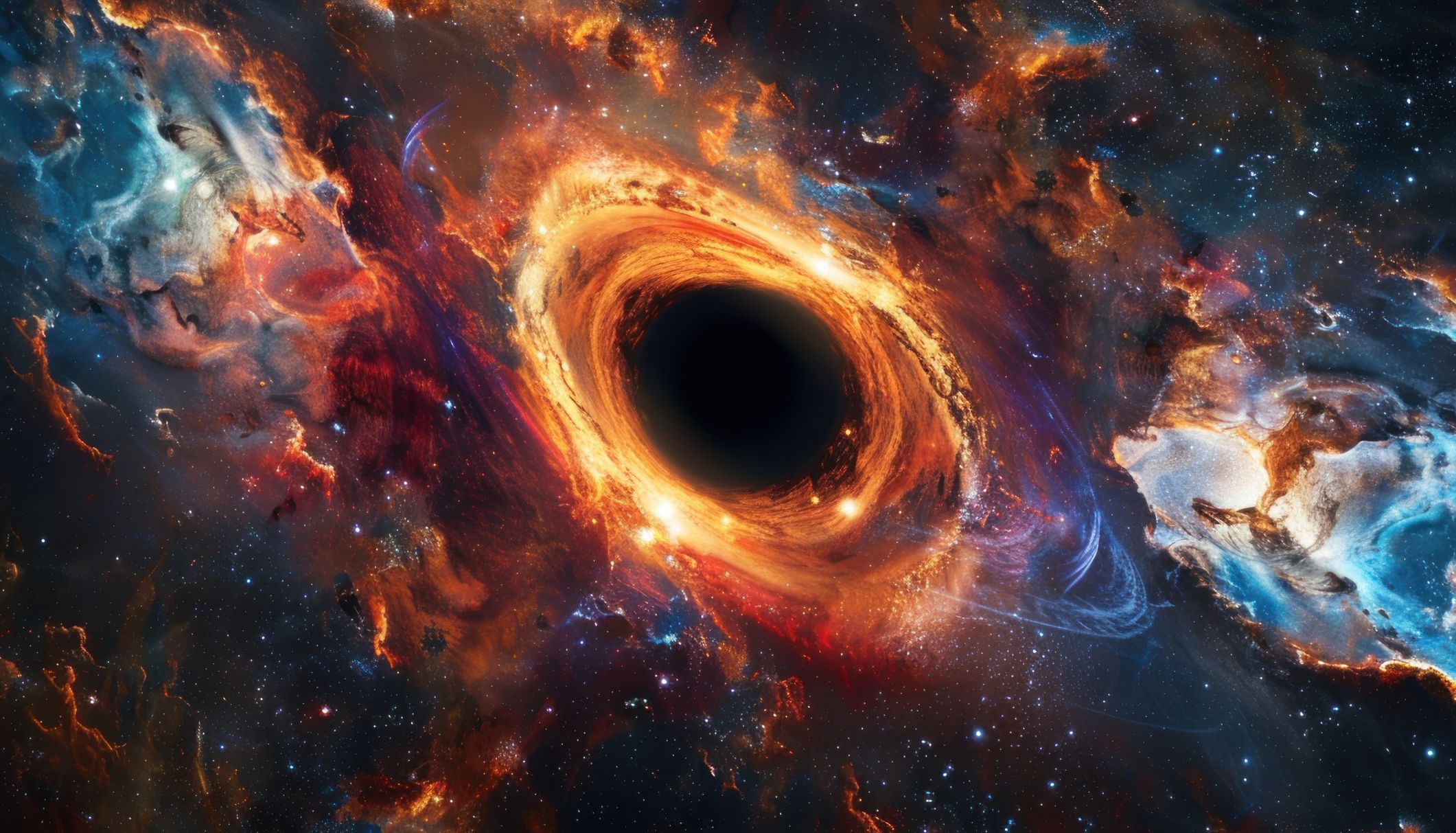
 Recent research suggests that the decay of dark matter may have accelerated the growth of supermassive black holes in the early universe, offering a possible explanation for some unexpected observations made by the James Webb Space Telescope.
Since it began operations in 2022, the telescope has detected the presence of black holes with masses equal to millions or even billions of times that of the Sun, already present 500 million years after the formation of the universe, which is now about 13.8 billion years old.
According to traditional models, however, a black hole would take at least a billion years to reach such enormous sizes. One of the theories proposed to explain this rapid growth suggests that black holes may form directly from large clouds of gas and dust, but the new research introduces dark matter as a possible catalyst for this process. Astrophysicist Alexander Kusenko of the University of California, Los Angeles (UCLA) and a member of the research team, compared the discovery of supermassive black holes at such an early stage of the universe to finding mammal bones among dinosaur remains in Jurassic sediments.
Kusenko hypothesized that radiation emitted by the decay of dark matter could have caused the collapse of gas clouds, leading them to rapidly form supermassive black holes. Dark matter, which makes up about 85% of the matter in the universe, represents one of the greatest mysteries of modern physics. Because it does not interact with electromagnetic radiation, it remains invisible to traditional instruments. However, some theoretical models suggest that some dark matter particles are unstable and can decay, emitting photons.
According to Kusenko’s team, this radiation could have played a crucial role in the rapid growth of black holes. The proposed mechanism implies that gravity can cause a large gas cloud to collapse, turning it into a supermassive black hole.
Kusenko explained that, while normally a gas cloud tends to fragment into smaller parts before forming a black hole, the cooling induced by radiation from dark matter decay could prevent this fragmentation, allowing the cloud to collapse into a single large-mass black hole. The research, published in Physical Review Letters, offers a new and potentially revolutionary perspective on the formation of black holes in the early universe, suggesting that the decay of dark matter may have been the key factor that allowed their growth in such rapid times compared to traditional theory expectations.
 Follow our feed