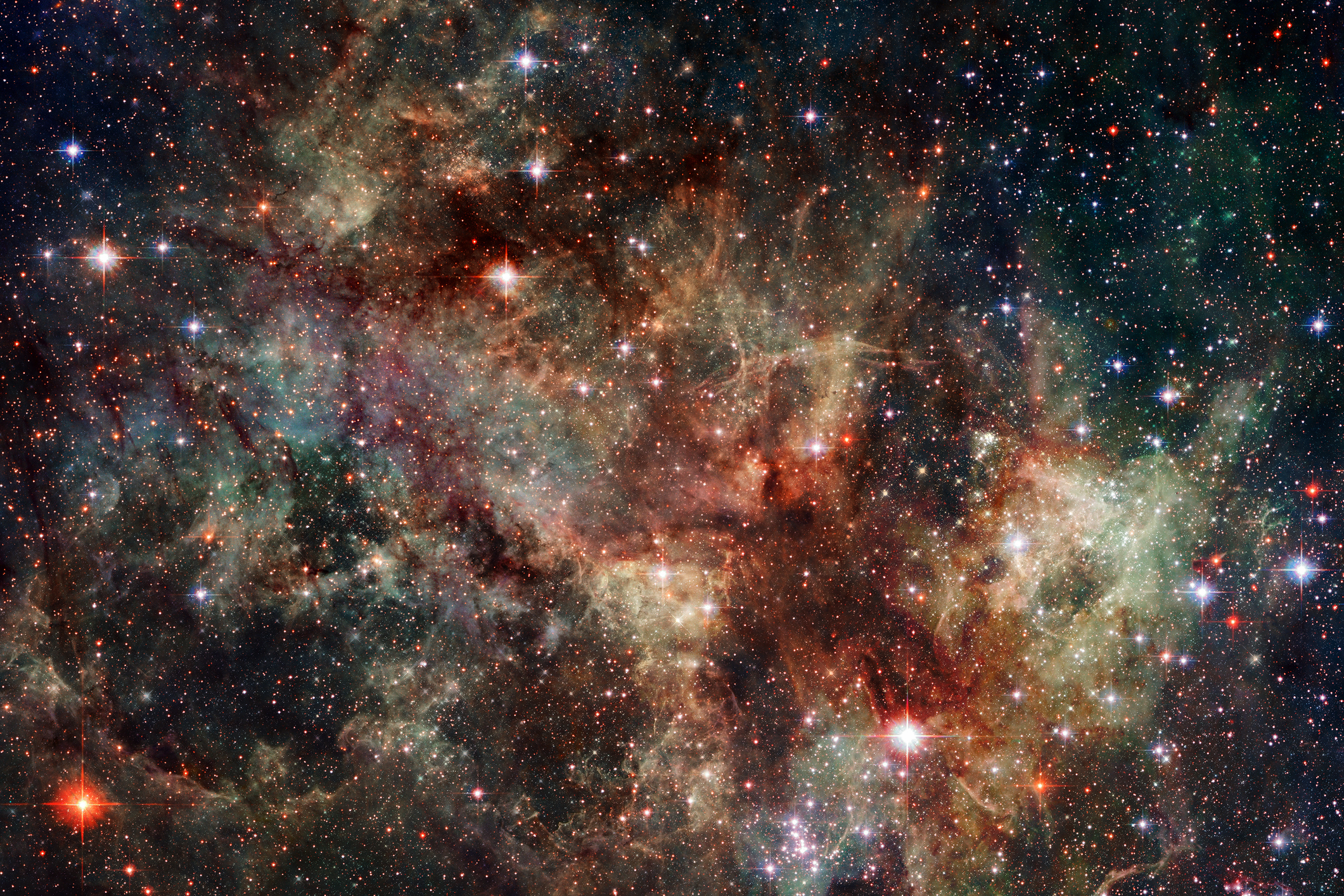
 The Solar System, in its movement through the Milky Way, periodically traverses regions of denser interstellar medium, mainly composed of hydrogen clouds and other materials.
The effects of these encounters on the Solar System and, in particular, on Earth are not entirely clear, but there are hypotheses suggesting that such events could have influenced the Earth’s climate, triggering, for example, ice ages. Recently, some studies have indicated that about 2 million years ago, the Solar System passed through a dense interstellar cloud, and this passage could have triggered an ice age.
Another research identified a second encounter, which occurred about 7 million years ago, that might have had more complex effects on our planet. These interstellar clouds would have had a significant impact on the heliosphere, the bubble of plasma generated by the Sun.
Scholars suggest that the two encounters, the first with the edge of the Local Bubble 7 million years ago and the second with the Local Lynx Cold Cloud 2 million years ago, caused an increase in the amount of interstellar hydrogen in the upper part of the Earth’s atmosphere. This hydrogen, combining with the oxygen present in the atmosphere, would have formed water.
The oxygen necessary for this reaction could have been taken from the ozone, leading to a significant decrease in it, in some cases up to 99%.
The greater amount of water at high altitudes would have favored the formation of noctilucent clouds, very thin clouds found between 76 and 85 kilometers in height. These noctilucent clouds, unlike those usually observed, could have been denser.
This raises crucial questions regarding their implications on the Earth’s climate.
Noctilucent clouds, in fact, could have reflected a greater amount of sunlight or trapped more heat coming from the Earth’s surface.
Other factors, such as the increase in cosmic rays, could have had a complex impact on global temperatures, without causing a net cooling or warming of the Earth’s climate. Researchers suggest that more precise three-dimensional atmospheric modeling is needed to clarify these complex atmospheric processes.
However, they admit that it might be difficult to definitively determine the contribution of interstellar clouds to climate variations, as it is not always evident in the available geological records.
The study, which sheds new light on how interactions between the Solar System and the interstellar environment could have influenced the Earth’s climate, was published in Geophysical Research Letters.
 Follow our feed