In recent years, the scientific community has observed a constant increase in average temperatures over seas, oceans, and land.
This phenomenon is linked to climate change on a global scale, primarily caused by excessive greenhouse gas emissions. The thermal rise, which may seem linear and unstoppable, however, hides some more complex consequences than one might think at first glance.
In particular, in the face of a general warming of the PLANET, there are increasingly frequent episodes of intense, sometimes sudden, and potentially record-breaking cold. These cold waves can be surprising because they occur even in generally milder periods, and often very quickly, giving the sensation of unexpected climate instability.
The process of global warming is now scientifically established. In addition to atmospheric evidence, where the concentration of carbon dioxide and methane has far exceeded pre-industrial levels, numerous repercussions are observed in the water sector.
Seas and oceans absorb much of the excess heat, leading to significant changes in ocean currents and atmospheric circulation. This phenomenon itself favors various meteorological anomalies, including prolonged periods of drought in certain regions and exceptional precipitation in others.
However, an even more complex aspect is the relationship between the gradual rise in temperatures and the risk of sudden cold waves.
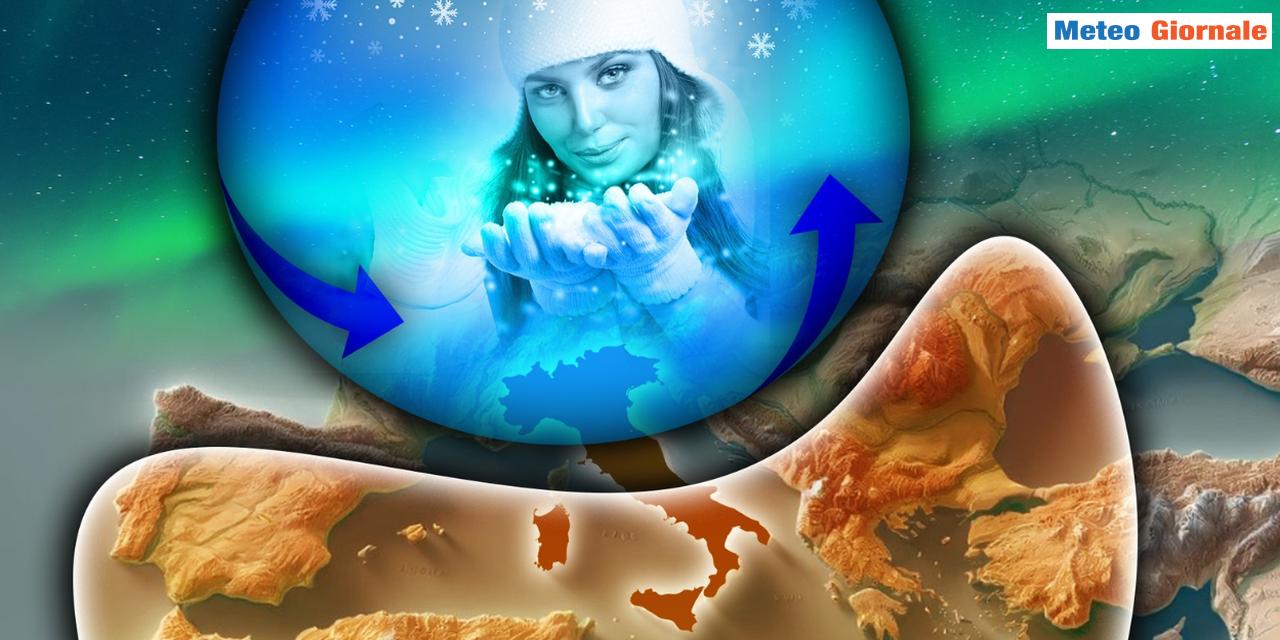
At the level of global circulation, the increase in thermal energy in the atmosphere can destabilize the Polar Vortex, a large area of low pressure that forms stably above the poles, especially above the ARCTIC.
This vortex, usually compact, is essential for keeping the cold trapped in polar regions.
However, when it becomes unstable, it can fragment or move from extreme regions, allowing polar cold to spill into lower latitudes. This can cause rapid and intense cold waves, sometimes even in southern EUROPE or northern AMERICA, where such severe conditions were once rarer.
Another fundamental element concerns the jet stream, the high-altitude air current that acts as an “air conveyor belt.” The jet stream is primarily driven by the thermal gradient between the poles and the EQUATOR.
With the ARCTIC warming faster than other regions, this temperature difference decreases, and the jet stream can slow down or undulate abnormally.
This wavy configuration allows cold air intrusions at lower latitudes, resulting in episodes of sharp and surprising cold in areas geographically distant from the poles.
In EUROPE, several emblematic cases have been observed. In March 2018, a mass of polar air, nicknamed “The Beast from the East,” crossed central-eastern EUROPE, bringing intense snowfalls to the UNITED KINGDOM, FRANCE, and parts of ITALY.
Despite average temperatures rising for the rest of the year, that week of bad weather had marked effects on the transport system and agriculture.
More recently, in February 2021, a sudden cooling hit SPAIN, with unprecedented snowfalls in MADRID and other cities, creating local emergency situations.
Outside of EUROPE, the states of northern AMERICA have experienced similar events. In January 2019, parts of the UNITED STATES were enveloped by arctic air currents that pushed the thermometer down to -22 °F in some locations, causing enormous disruptions to infrastructure and the population. Subsequently, in February 2021, TEXAS experienced an unprecedented cold wave in terms of intensity, with temperatures dropping well below freezing, paralyzing energy plants and creating a severe electricity crisis.
In East ASIA, specifically in parts of CHINA, snowstorms have surprised residents, in a context of climate changes that seem to make the weather more variable.and less predictable.
Despite these episodes of anomalous cold, long-term observations indicate that global temperatures continue to rise. Data collected by the IPCC (Intergovernmental Panel on Climate Change) show that every decade since 1980 has been warmer than the previous one, with a particularly significant impact on polar ice.
The paradox lies precisely at the intersection between a climate that, is warming and localized phenomena of extreme cold. Scientists hypothesize that, in some circumstances, the extra energy stored in the ocean and atmosphere may favor a displacement or a temporary collapse of polar air masses, thus generating periods of exceptional cold. These periods might be shorter than in the past, but no less intense.
Some studies suggest that high thermal variations on marine surfaces, especially in the waters of the MEDITERRANEAN SEA and other coastal areas, can increase evaporation and atmospheric humidity.
The latter, when it encounters masses of very cold air, favors the formation of sudden storms and anomalous snowfalls. The mechanism is quite complex and depends on the balance between regional and global factors. The decrease in polar ice in the ARCTIC, for example, frees large sea surfaces to solar radiation, amplifying the ocean’s warming process and, in turn, altering atmospheric circulation.
Meanwhile, areas like SIBERIA can act as reservoirs of very cold air, which, when it finds a clear path, rushes southward rapidly.
On our PLANET, increasingly extreme events, from heatwaves to sudden cold spells, highlight the growing complexity of the Earth’s climate.
Sometimes one might be led to think that an anomalous winter disproves the phenomenon of global warming, but in reality, such fluctuations only confirm the existence of a constantly changing climate dynamic.
The average increase in temperatures on a global scale remains a fact, yet the presence of extraordinary cold events is a corollary, due to mechanisms that redistribute thermal energy irregularly.
The focus of contemporary scientific research is on predicting sudden cold waves, which pose a problem for the agricultural sector and infrastructure management.
Although some weather models are becoming more accurate, the element of unpredictability remains high, especially when it comes to estimating the exact timing and duration of these episodes.
The large amounts of data collected by satellites and weather stations scattered around the WORLD provide valuable information, but the climate is a complex system in which physical, chemical, and biological components intersect.
Even small variations in one of these elements can lead to sudden changes, such as sudden cold waves.
In the context of climate change adaptation and mitigation policies, understanding the correlation between thermal increase and these cold peaks is crucial. Reducing carbon dioxide and other greenhouse gas emissions remains the primary goal, but preventing damage caused by extreme climate fluctuations also plays a fundamental role.
Aspects related to the communication of climate and weather phenomena should not be underestimated. Often, the idea of global warming is simplified by associating it exclusively with an increase in temperatures and hotter summers.
In reality, the effect of climate forcing also manifests with opposite thermal shocks, which can bring snow and cold to areas less accustomed to such conditions.
It is therefore essential to continue raising public awareness, explaining that a warmer climate on a global scale does not exclude periods of sudden or even exceptional cold.
On the contrary, these events could prove to be further evidence of the trend towards greater and more pronounced variability.
The science of the coming years will ultimately have the task of deepening and clarifying the mechanisms behind such episodes of intense cold, highlighting their connection with global climate dynamics.
Understanding how the Polar Vortex, the jet stream, and the ocean intersect in a context of constantly rising average temperatures will allow for better prediction of cold waves in regions accustomed to milder winters.
The most important aspect remains the awareness that, despite a generalized increase in heat, the climate system can produce significant weather surprises, sometimes shorter but no less impactful.
The past.
the correlation between climate change and sudden cold waves is not a contradiction but a demonstration of the extreme complexity of the Earth’s atmosphere.
The trends of warming and anomalous cooling are part of the same evolutionary framework, where the irregular distribution of energy can lead to extreme phenomena. Understanding and managing these events is becoming increasingly urgent, as their occurrence, although sometimes unpredictable, is a reality that will continue to reappear on our PLANET in the years to come.
 Follow our feed