We are observing the mathematical models very closely, models that in the recent period have shown significant evolutionary uncertainties, and such uncertainties do not help in drafting a univocal weather forecast.
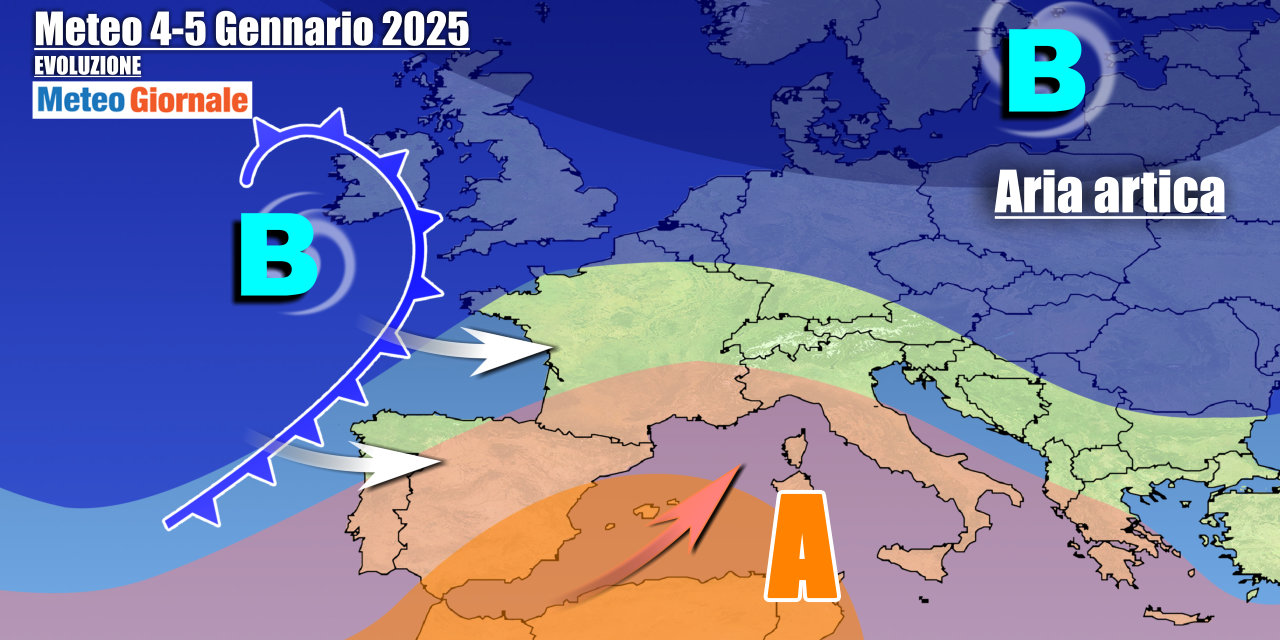
What emerges, however, is the persistence of a certain atmospheric dynamism whose effects will be evident in the coming days. We expect, in fact, the passage of two cold impulses between Northern Italy and Adriatic regions, impulses attributable to the massive cold wave that is about to hit much of the old continent and with effects on our regions partly limited by the presence of High Pressure. High Pressure that will manage to prevail over the western sectors, while as mentioned it will not be able to fully protect the North and eastern regions where we will have two distinct deteriorations.
Deteriorations that will bring a drop in temperatures and locally lively precipitation, with possible snowfalls at relatively low altitudes. Snow will fall abundantly especially on the northern slopes of the Alps, more exposed to the European Arctic invasion.
But there will be other snowfalls on the Apennine ridge, and we will understand if and how they will manage to reach low altitudes. As for the subsequent evolution, the positioning of the High Pressure will certainly need to be monitored, which apparently around mid-month could push more decisively northward, triggering fully winter dynamics even at our latitudes. It should be noted that in some model emissions it is possible to glimpse the formation of a true anticyclonic block, capable – if confirmed, of course – of sucking in the icy air present over Eastern Europe and pushing it into the heart of the Mediterranean. Clearly, such a dynamic would open the doors to a powerful cold incursion. Cold or frost, much will depend on the exact trajectory of the potential block.
But what matters at this moment is to avoid the constant anticyclonic presence over the Mediterranean, and this is a hypothesis not to be underestimated, because in that case, the winter season would suffer a prolonged stop. We remain confident, however, that January, like December, will be able to offer us moments of extreme atmospheric dynamism, during which the cold could take over.
 Follow our feed