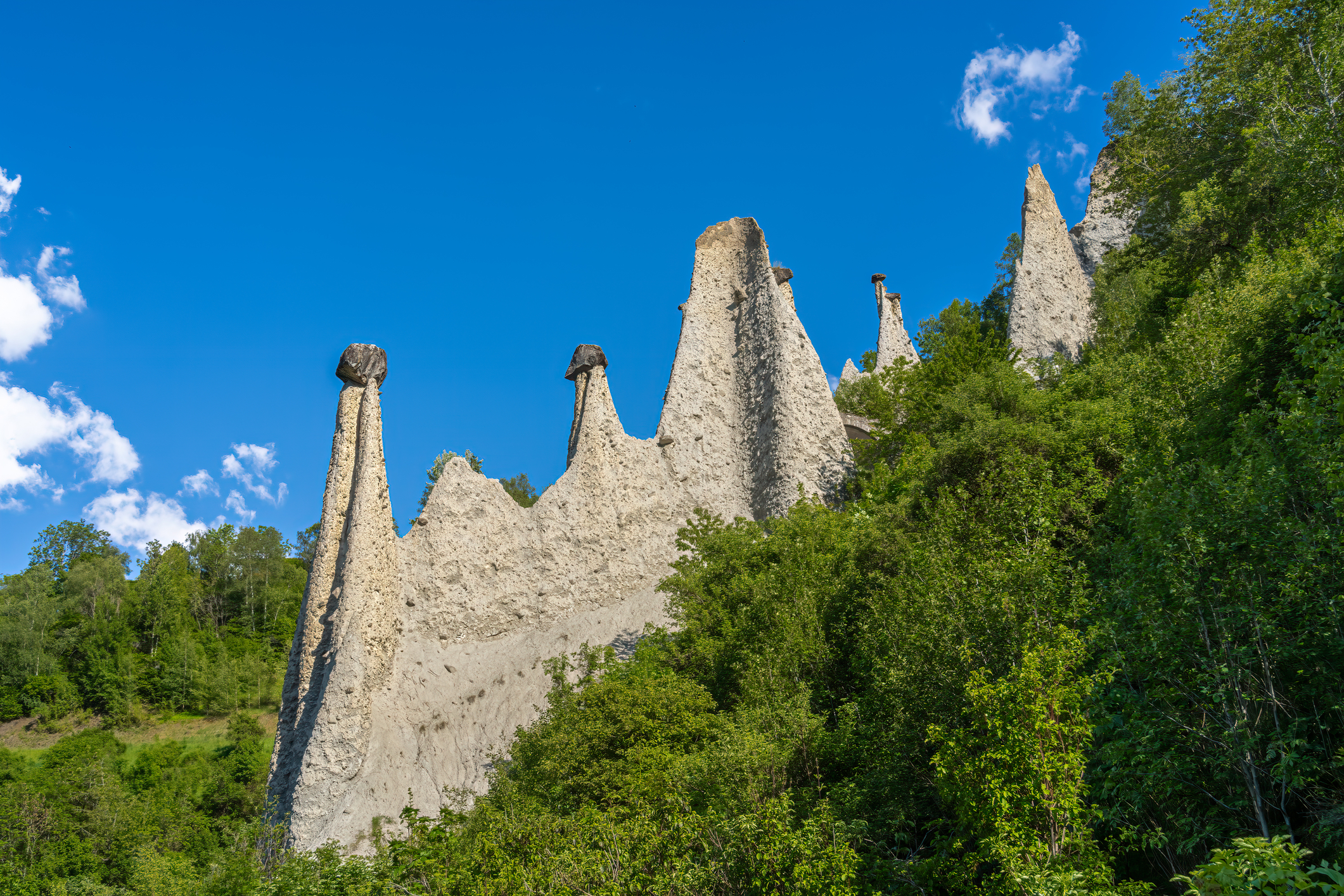
 In the picturesque Val d’Hérens valley, in the heart of the Swiss Alps, lie the extraordinary Pyramids of Euseigne, one of the most fascinating geological wonders in Europe.
These formations, standing between 33 and 49 feet tall, are the result of complex erosive processes that occurred during and after the last Ice Age, which ended about 10,000 years ago.
Glacial origin and formation
The Pyramids of Euseigne were formed during the retreat of the glaciers when rising temperatures caused the melting of the enormous glacial tongues that once occupied the valley.
During this process, the glaciers left behind a mixture of materials: the moraines, composed of softer sediments, and large hard rock boulders. Rainwater and meltwater began to erode the more fragile materials, while the resistant boulders left on top protected the underlying columns.
This mechanism gave rise to the current structures, with the boulders acting as natural “hats,” slowing down the erosion of the moraines on which they rest.
A global geological phenomenon
These columns are also known as hoodoos or fairy chimneys, terms used in other parts of the world to describe similar formations.
Such structures are found in various regions where rocks of different hardness are exposed to similar erosive processes, creating spectacular and unique landscapes.
Recognition and scientific value
In 1983, the Pyramids of Euseigne were included in the Swiss Federal Inventory of Landscapes and Natural Monuments of National Importance, a recognition of their aesthetic and scientific uniqueness.
These formations are not only a tourist attraction but also an important testimony to the long-term effects of geological processes on the Earth’s landscape.
The fragile beauty of nature
Despite their apparent solidity, the Pyramids of Euseigne are destined to disappear over time.
The continuous erosive action of water and atmospheric agents will inevitably destroy these structures, making them an eloquent symbol of the transience of nature.
A breathtaking accessible landscape
A unique experience for visitors is offered by the mountain road that crosses the Pyramids, allowing close observation of these extraordinary formations.
The contrast between the moraine columns and the surrounding alpine landscapes makes the place a must-see for nature and geology enthusiasts.
An example of the impacts of glaciation on the landscape
The Pyramids of Euseigne are a concrete demonstration of how natural processes, although slow, can shape our planet in spectacular ways.
Their history, intertwined with that of the glaciers of the Alps, offers a unique opportunity to understand the dynamics that have shaped many of the mountain landscapes we know today.
 Follow our feed