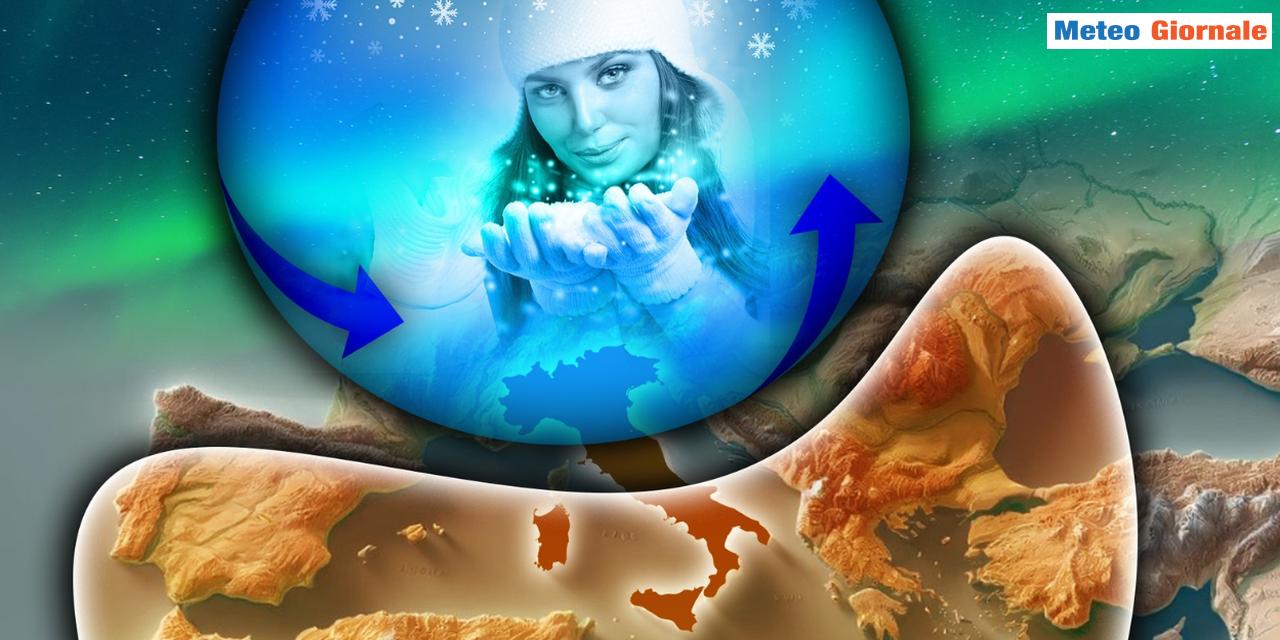
In Italy and much of Western-Central Europe, the anticyclonic ridge remains firmly dominant, ensuring stable weather and hindering the arrival of Atlantic disturbances.
However, the Mediterranean shows signs of renewed activity, becoming a theater of contrasts between air masses of different origins. Some rains are affecting Sicily, and soon these precipitations will extend to Sardinia.
On the rest of Italy, however, the anticyclone will continue to prevail, maintaining clear skies and mild temperatures.
Conversely, the regions of Scandinavia, the Baltic States, and European Russia are already experiencing or have recently experienced winter scenarios, with cold temperatures and widespread snowfalls down to the plains. After an October marked by abundant rainfall in many European countries, autumn seems to have suddenly disappeared.
Currently, while Western-Central Europe enjoys almost spring-like weather, Eastern Europe and especially Russia are already in a typically winter atmosphere.
The lack of Atlantic currents negatively affects many areas of the Continent, causing drought conditions that amplify the climatic anomaly of this period.
Temperature drop and winter cold next week
The weather forecasts for the coming days indicate that the anticyclone will continue to dominate, blocking significant disturbances coming from the Atlantic. Curiously, however, it is more likely that cold currents from the east will reach Italy, causing a noticeable drop in temperatures, which will be felt particularly along the Adriatic regions starting from the weekend. According to the European model ECMWF, between the 11th and 12th of November, an early cold wave could occur. In this scenario, the anticyclone will retreat towards the United Kingdom and extend its influence towards Scandinavia, paving the way for an influx of cold air from Eastern-Central Europe.
This air mass will move until it reaches the Central Mediterranean, leading to a marked drop in temperatures. The first seasonal snowfalls could affect the mountainous areas, both Alpine and Apennine, and could also occur at relatively low altitudes.
However, the exact trajectory of this possible cold outbreak is still uncertain and requires further confirmation in the next updates.
 Follow our feed