Dear readers, have you ever wondered how weather experts try to study the snow cover in Siberia between November and December? Simple, it can influence the weather trend in Europe and, indirectly, also in Italy. But it’s not all… straightforward.
Let’s see what we can say.
Effects of Siberian Snow and Atmospheric Dynamics
The presence of significant snow cover in Siberia causes a considerable cooling of the ground, favoring the strengthening of the Russian Siberian Anticyclone.
This very powerful anticyclone interacts with planetary waves in the troposphere, transferring energy to the upper layers of the atmosphere.
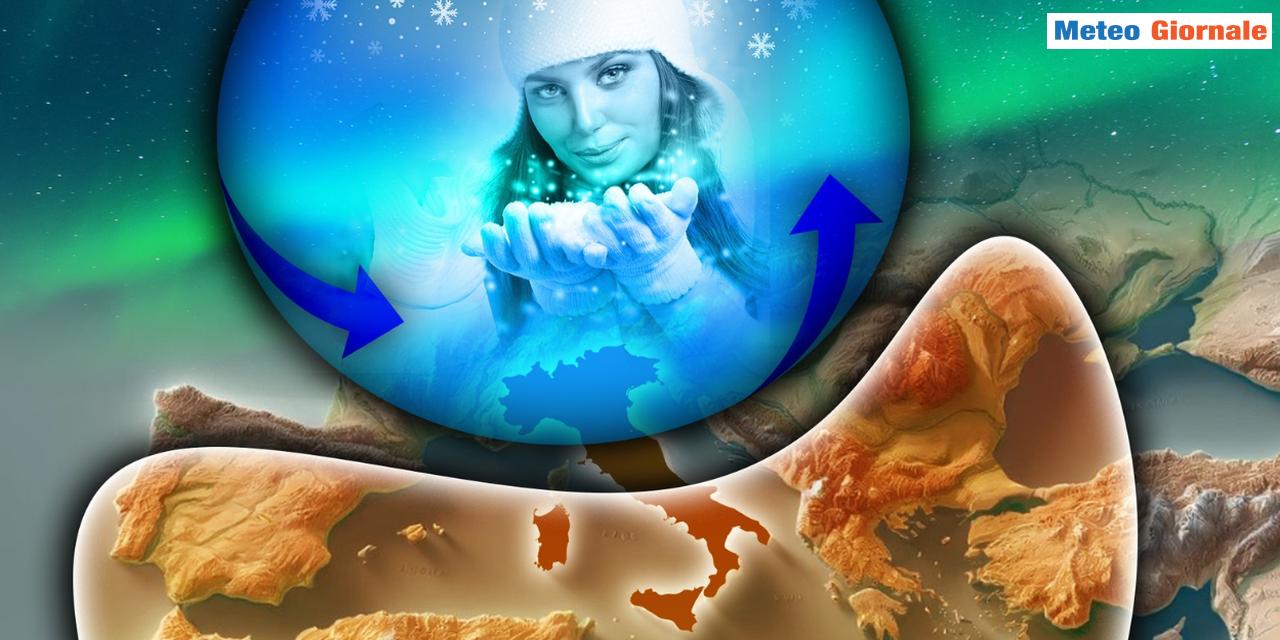
The resulting fluctuations in the stratosphere often lead to a weakening of the Polar Vortex, which can be further destabilized by phenomena such as sudden stratospheric warmings (SSW). These dynamics can cause deviations in air currents, pushing cold air masses towards Europe and Italy, creating conditions of frost and snow even at low altitudes. It is logical that for such a weather configuration, several atmospheric factors need to combine.
Arctic Ice and Climate Interactions
Another key element is the variation in Arctic sea ice cover, particularly in the Barents-Kara Sea regions.
When the ice in these areas reaches a significant extent during the Autumn, it favors snow accumulation in Siberia.
This phenomenon further strengthens the interaction between the cold ground and the atmosphere, intensifying the processes that destabilize the Polar Vortex. The weakening of the stratospheric Polar Vortex, caused by SSWs, increases the likelihood of cold air masses pushing towards temperate latitudes.
This phenomenon makes winter cold waves more likely, often accompanied by extreme weather conditions such as heavy snowfall and sub-zero temperatures (below 32°F) in many areas of Europe.
Let’s Not Jump to Easy Conclusions
The relationship between Siberian snow and frost in Italy is not automatic.
Although the described processes can increase the risk of cold waves, the possibility of these reaching our latitudes depends on precise atmospheric configurations and not just on local frost. The arrival of Siberian air in Italy requires a robust Anticyclone to establish itself at high latitudes, allowing cold air to flow from the east towards the Mediterranean.
However, this phenomenon is relatively rare, and it was even rare in the past.
Even in years with abundant snowfall in Siberia, Italy could experience a mild Winter if other climatic factors, such as the position of the Polar Vortex, do not align correctly.
Winter Considerations
In the winter season, it remains to be seen whether conditions will be created for a significant cold wave in Italy.
Long-term weather models are monitoring the dynamics of the Russian Siberian Anticyclone and variations in snow cover in Siberia.
If these interactions lead to a weakening of the Polar Vortex, we could observe episodes of intense cold during the season. But be careful: there is no direct and certain correlation between snow in Siberia and cold waves in our country! In short, the factors at play are quite different. Even the possible presence of an Azores Anticyclone, which often protects the Mediterranean from cold incursions, could limit the arrival of frost in Italy.
Conversely, an anomalous positioning of the anticyclone could leave room for more frequent cold incursions, especially in Northern Italy and along the Adriatic. So, even the Azores anticyclone has many uncertainties for the future.
So let’s not take for granted what is not certain…
 Follow our feed