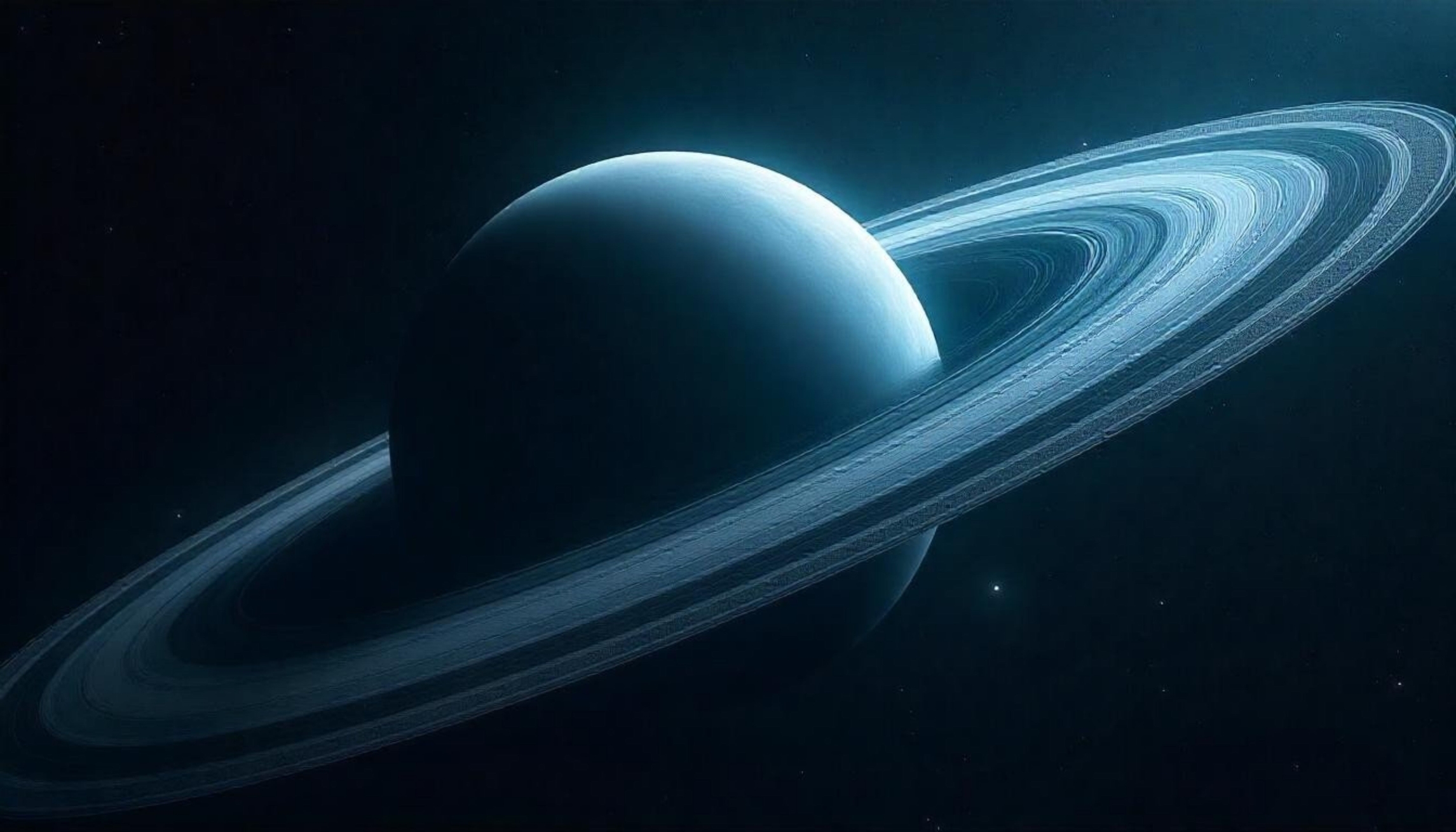
 In the course of 2025, Saturn will offer a rare astronomical spectacle: its famous rings will seem to disappear when observed from Earth.
This curious phenomenon occurs at regular intervals of 13-15 years, due to the tilt of the planet’s axis relative to our point of view. Even though the rings will not be visible, they will remain intact, continuing to orbit the planet as always.
Why do the rings become invisible?
The orientation of Saturn, with its axis tilted at 26.7 degrees, causes the rings to periodically appear edge-on from Earth during its orbital motion.
This particular alignment makes the rings extremely thin when observed from our perspective, to the point of almost disappearing.
Between March and November 2025, the rings will reach their maximum edge-on tilt, making the planet less bright than usual in the night sky.
An opportunity for astronomers
Saturn’s rings, composed mainly of ice particles, reflect a large amount of sunlight.
When they appear edge-on, the overall brightness of the planet decreases, offering better visibility of other celestial objects nearby, usually obscured by Saturn’s brilliance.
This condition creates a unique observation window to study details of the surrounding solar system.
The structure of the rings and shepherd moons
Saturn’s rings are not just a scenic element but represent a scientific marvel due to their complex structure. Their shape and composition are strongly influenced by gravitational interactions with the so-called shepherd moons, small satellites that orbit near the edges of the rings.
These satellites exert a force that stabilizes the ring material, preventing dispersion and helping to maintain order in the system.
The gradual disappearance of the rings
Despite their apparent eternity, Saturn’s rings are destined to disappear in a relatively distant future.
Recent research indicates that they may be much younger than the planet, with an estimated age of about 100 million years. Moreover, their fate seems sealed: ice and dust particles are gradually falling into Saturn’s atmosphere, a process that will lead to their dissolution within 100-300 million years.
Observing the phenomenon in 2025
For astronomy enthusiasts, 2025 represents an unmissable moment to observe Saturn in this particular configuration.
A telescope, even a small one, will be sufficient to follow the progressive “disappearance” of the rings.
However, instruments like astronomical binoculars will not guarantee adequate resolution to appreciate the details of the phenomenon.
Subsequently, starting from 2032, the rings will return to their optimal position to be admired in their full magnificence.
 Follow our feed