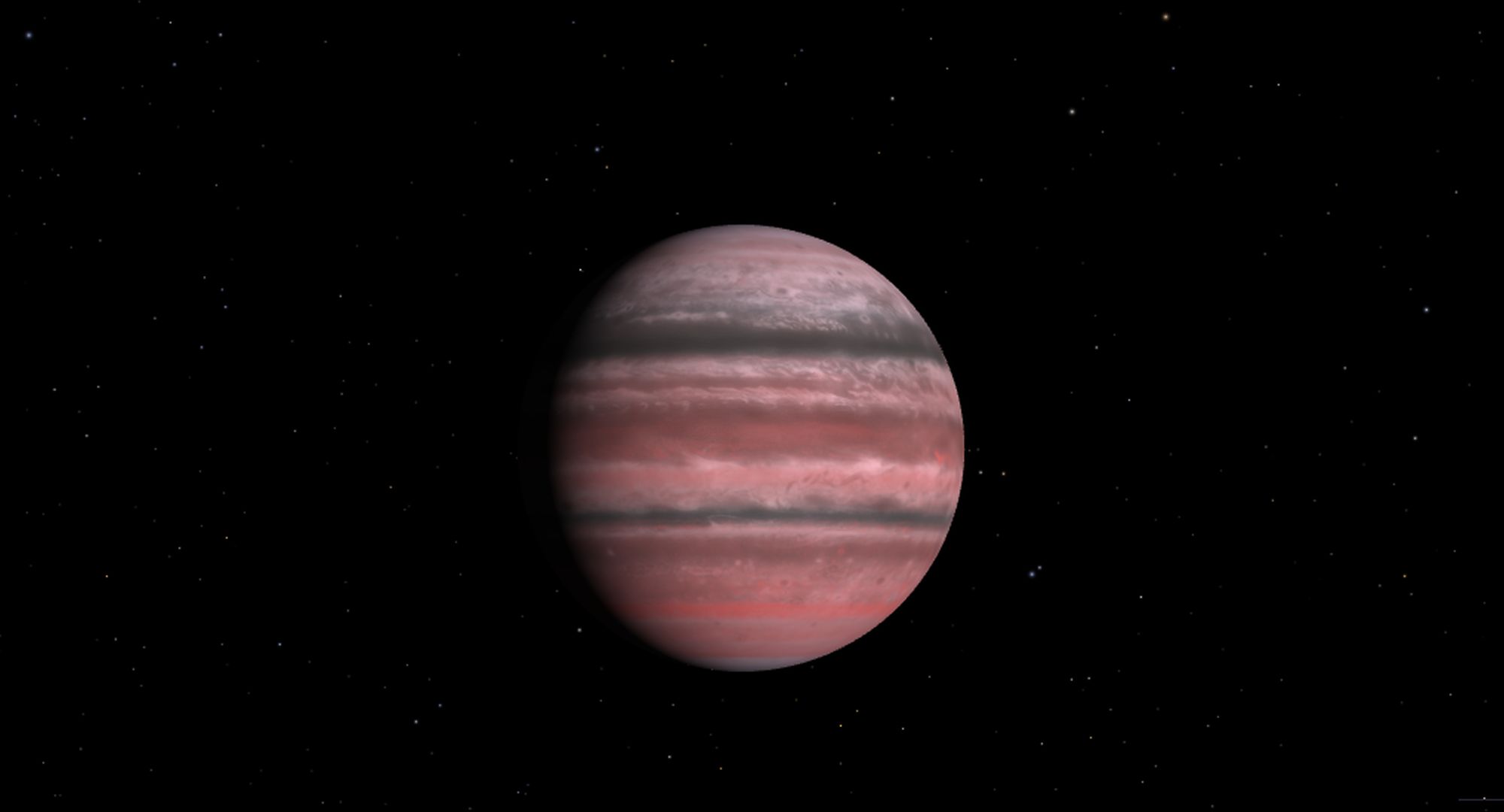
 The James Webb Space Telescope (JWST) has recently revealed an extraordinary observation: an exoplanet located 97 light-years from Earth, named GJ 9827 d, enveloped in a dense layer of water vapor.
This planet represents a unique case, being the first known example of a true “steam world”.
With a mass three times that of Earth and dimensions about twice as large, its atmosphere is almost entirely composed of water vapor. Despite the abundant presence of vapor, GJ 9827 d cannot be considered a habitable candidate according to the parameters we know on Earth.
However, the study of this exoplanet offers an important opportunity to better understand other small exoplanets that might be in a habitable zone, situated between the sizes of Earth and Neptune. The discovery of its water vapor-rich atmosphere was made possible through the technique of transmission spectroscopy, which analyzes starlight as it passes through the planet’s atmosphere.
This methodology allows for the identification of which elements absorb light at specific wavelengths, leaving “fingerprints” in the light spectrum that reveal the presence of specific elements in the atmosphere. Until now, most exoplanets analyzed through spectroscopy showed atmospheres dominated by light elements, such as hydrogen and helium, which are also common in the gas giants of our solar system, like Jupiter and Saturn.
However, the atmospheric characteristics of GJ 9827 d are very different, opening new perspectives on atmospheres more similar to those of terrestrial planets. The importance of this discovery lies in the fact that for the first time, a planet with an atmosphere rich in heavy molecules, like those present on the rocky planets of our solar system, has been identified.
This represents a significant advancement in the study of exoplanets and the understanding of their composition. GJ 9827 d was originally identified in 2017 by the Kepler space telescope.
It orbits at a distance of only 8.4 million kilometers from its star, GJ 9827 – 6% of the distance between Earth and the Sun – completing an orbit in just six Earth days.
This exoplanet is the third among the three known planets orbiting this star. Thanks to the sensitivity of the JWST and its NIRISS instrument, the team was able not only to confirm the preliminary data collected by the Hubble Space Telescope in 2023 but also to establish with certainty that GJ 9827 d is enveloped in water vapor.
This discovery opens new research possibilities on water worlds in the universe and further pushes the limits of our astronomical understanding, offering a deeper look into the atmospheric conditions that can exist on planets outside our solar system.
 Follow our feed