Among the climate indices capable of having a significant impact on winter weather in Italy, the NAO, the so-called North Atlantic Oscillation, also stands out.
It is a pattern of atmospheric circulation that has a cyclical trend and is located in the North Atlantic Ocean. The NAO is characterized by the cyclical fluctuation of the sea-level pressure difference between Iceland and the Azores. It is created through the east-west oscillation motion of the Icelandic low and the Azores high, determining the strength and direction of the westerly zonal flow. This oscillation manifests in two phases, one positive and one negative, with distinct meteorological and climatic consequences.
In this article, we will focus on the negative phase of the NAO, considering that it can favor significant winter cold events, in the past even with record snowfalls. During the negative phase, both the subpolar low (near Iceland) and the subtropical high (near the Azores) are weaker than average.
This anomaly in atmospheric pressure affects the strength and direction of the Atlantic jet streams, which tend to weaken, favoring anticyclonic circulations. In recent weeks, the NAO has settled at negative levels and may be a harbinger of the prevailing circulation for the upcoming winter.
Not surprisingly, this and other climate indices are imprinting a pattern that could favor below-average temperatures starting from the end of the first decade of December.
Storms and intense cold heading towards the Mediterranean
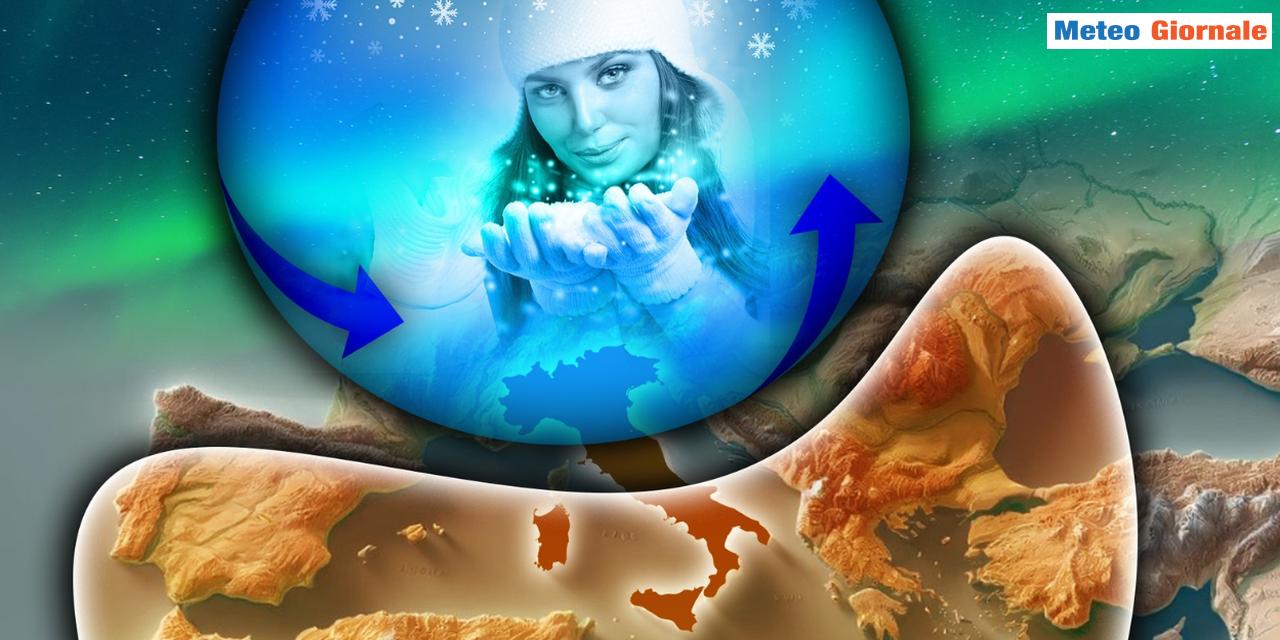
In these situations, the path of the storms tends to shift to lower latitudes over the Mediterranean, where it interacts with descents of cold or frigid air.
Precipitation in these regions tends to be above average, unlike in northern areas of Europe. The impact of the negative NAO is closely linked with the Polar Vortex and the Arctic Oscillation (AO).
When the AO is also negative, an interaction occurs between these two climate teleconnections.
In this scenario, cold Arctic air can move southward, reaching southern Europe and the Mediterranean. This movement of cold air masses to lower latitudes can lead to significant episodes of bad weather and cold, including abundant snowfalls at low altitudes, even for prolonged periods.
In Italy, these climatic events can manifest with extreme meteorological phenomena.
 Follow our feed