Analysis of the Meteorological Phenomenon: Stratocumulus Volutus
Description of the Phenomenon
Characteristics of Stratocumulus Volutus Clouds
Recently, a meteorological phenomenon has attracted attention in northern Uruguay, in Cerro Largo.
It is an impressive cloud formation, captured in a video and shared by the National Meteorological Service.
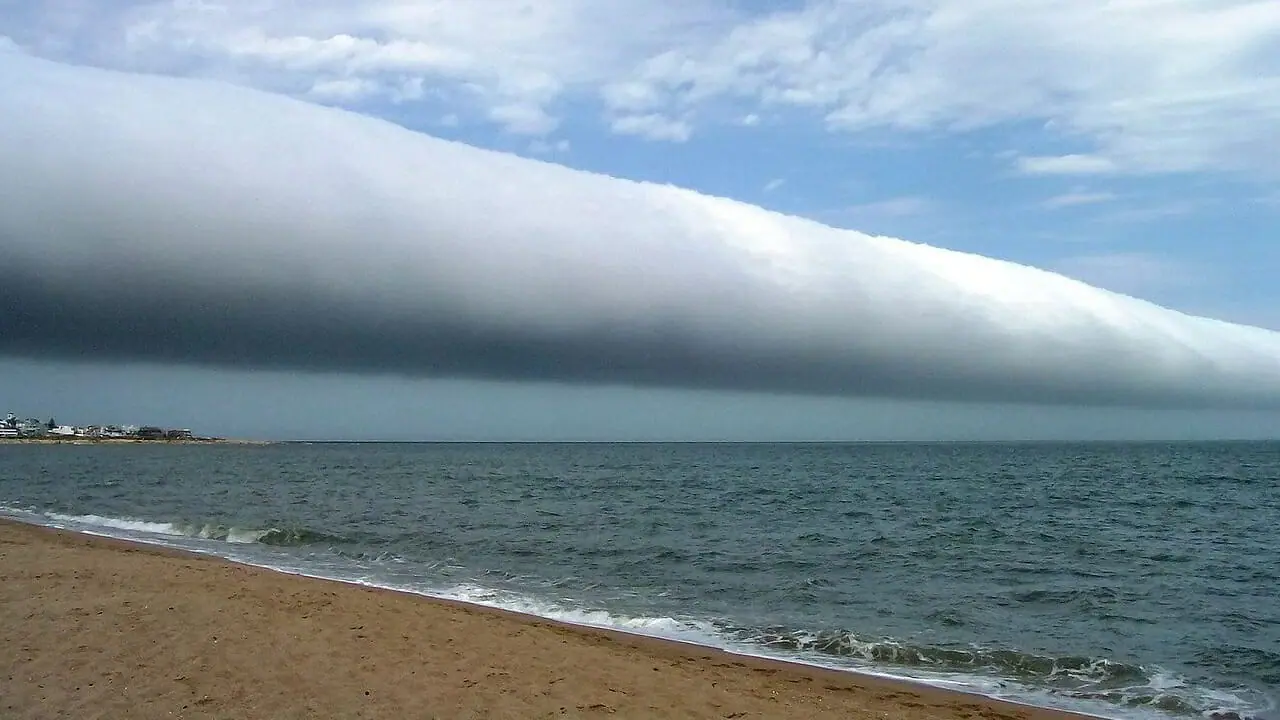
These clouds, known as Stratocumulus Volutus, are low tubular-shaped clouds.
They are typically visible at the end of the dry season, from September to mid-November, in the Gulf of Carpentaria, in northeastern Australia, where they are known as Morning Glory.
However, they can also be observed in other parts of the world.
Stratocumulus Volutus are roll-shaped clouds with a typical width of 1 or 2 km and lengths exceeding 100 km, sometimes occupying the entire sky from horizon to horizon.
These clouds can travel alone or in groups and move quickly, at average speeds of 30-45 km/h.
Presence of Altocumulus Lenticularis
In the video, on top of the Stratocumulus Volutus, another type of cloud is visible.
These are laminar-shaped clouds, with soft, wavy edges and a bright white color.
These clouds are called Altocumulus Lenticularis and are of medium type, often visible in mountainous areas.
The presence of these clouds indicates strong turbulence and wind shear at mid-levels of the troposphere.
Atmospheric Waves and Surface Effects
Generation of Atmospheric Waves
The Volutus and Lenticularis represent the visible part of an atmospheric wave.
Just as there are waves in the sea, there are also atmospheric waves because air is a fluid like water, subject to turbulence.
These waves can be generated by the interaction of the airflow with an orographic obstacle, for example.
Sometimes, Stratocumulus Volutus are associated with cold air coming out of storms and moving like a surface cold front (gust front).
The gust front is therefore a separation zone between two air masses of different temperature and density.
In this case, it is difficult to determine whether these clouds were associated with nearby storms.
For this, radar images or an animation of the visible channel of the Meteosat satellite are essential.
Effects of Stratocumulus Volutus on the Surface
The passage of waves associated with Stratocumulus Volutus produces pressure oscillations on the surface, easily detectable on a barograph.
After the waves, the pressure increases and remains stable for several hours.
In some cases, the pressure increase is more than one millibar in a few minutes.
With the passage of these clouds, the wind tends to strengthen, becomes gusty, and changes direction.
The duration usually does not exceed five minutes and is associated with each individual roll.
Although the wind associated with the Morning Glory is rarely intense, these clouds are monitored at airports due to the abrupt changes in direction that can affect the organization of takeoffs and landings.
Stratocumulus and Altocumulus rarely produce precipitation, and it is always weak in nature.
In Stratocumulus Volutus, the vertical development of the cloud usually does not exceed 1000 meters, so precipitation is rare in these cases.
This type of laminar cloud requires atmospheric stability with horizontal wind flows.
 Follow our feed