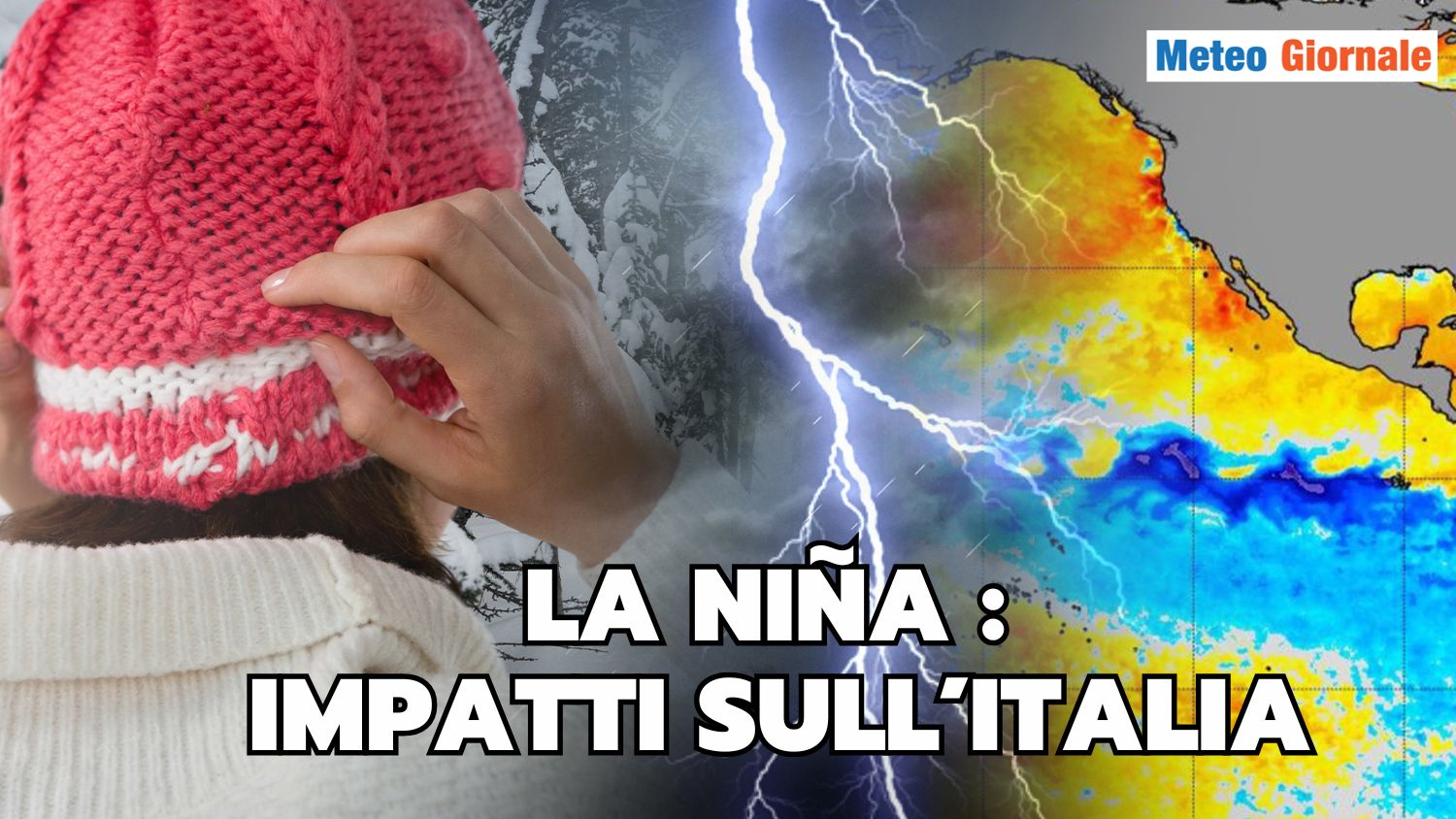
 The analysis conducted by NOAA, the National Weather Service, and other affiliated institutions confirms the updates regarding the La Niña phenomenon, which represents the cold phase of the ENSO (El Niño-Southern Oscillation) cycle.
This phenomenon occurs when the water temperature in the Pacific Ocean is colder by 0.5°C (32.9°F) or more compared to the average for at least five consecutive months.
During La Niña episodes, significant changes also occur in the atmospheric winds in the tropical Pacific, with a strengthening of the Walker circulation, reaching its peak activity. In detail, the La Niña phase is characterized by an anomalous shallow warm water layer that extends across the entire eastern tropical Pacific, resulting in an increase in the thermocline slope.
This phenomenon leads to a lowering of the surface ocean temperatures in the central and eastern equatorial Pacific. La Niña is a phenomenon of periodic cooling of surface temperatures in the equatorial Pacific Ocean, with an irregular cycle that repeats every 3-5 years.
Here is what the official NOAA Report tells us
In November, ENSO conditions remained neutral, with sea surface temperatures (SST) in the central and eastern equatorial Pacific Ocean remaining near average.
The weekly Niño indices ranged from +0.1°C (32.2°F) (Niño-1+2) to -0.4°C (31.3°F) (Niño-3), with below-average ocean temperatures in the central-eastern and eastern equatorial Pacific Ocean. Easterly low-level wind anomalies and westerly upper-level wind anomalies were observed over the western and central equatorial Pacific.
Convection was suppressed along the dateline, while it was enhanced over western Indonesia.
The Southern Oscillation indices were positive, indicating an ocean-atmosphere coupling that reflected ENSO-neutral conditions. Forecast models suggest a possible weak and short-lived La Niña, with Niño-3.4 index values below -0.5°C (31.1°F).
This scenario is confirmed by the North American Multi-Model Ensemble (NMME), which predicts slightly cooler SST temperatures and weak La Niña conditions.
According to these forecasts, La Niña could emerge between November 2024 and January 2025, with a probability of 59%.
Subsequently, a transition to neutral conditions is expected between March and May 2025 (probability of 61%). although a weak La Niña is forecasted, the winter climate impacts are expected to be limited.
 Follow our feed