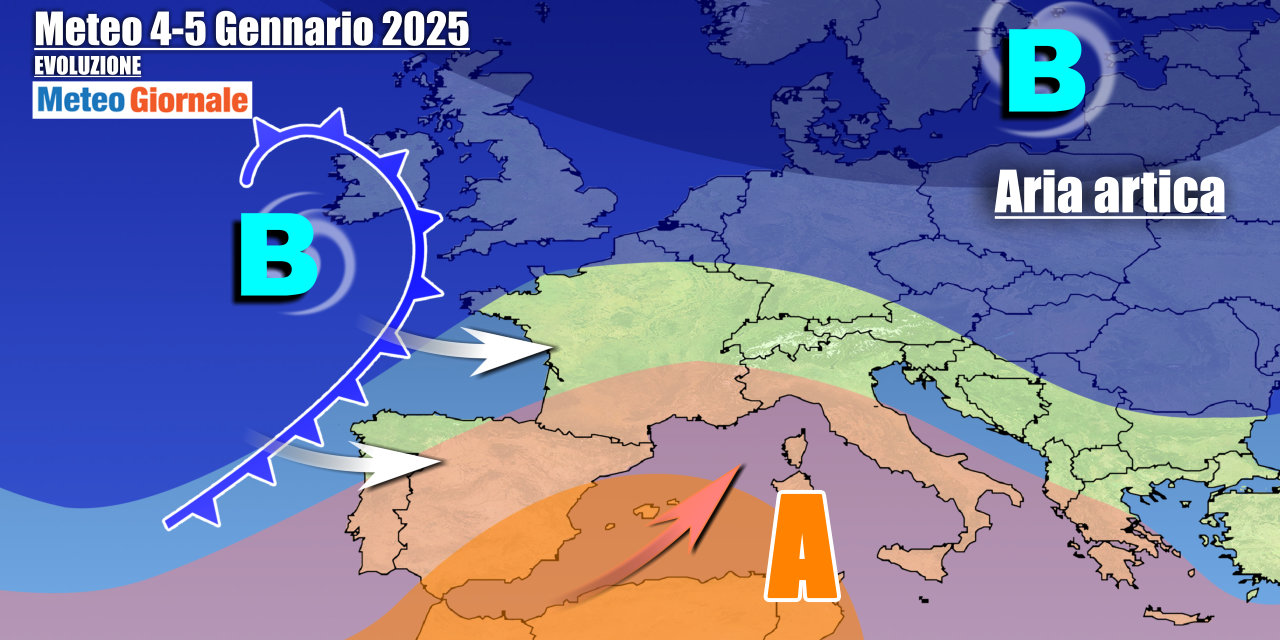
The current weather conditions in Italy are strongly influenced by an incursion of Arctic air that has led to a significant temperature drop and intense bad weather phenomena, especially in some areas where the Mediterranean cyclonic vortex has shown greater intensity. The most affected regions are mainly between Northern Italy and the Tyrrhenian areas of Central Italy, while the effects in Southern Italy have been less marked but still significant. The vast cyclonic structure currently active tends to move westward, heading towards the Iberian Peninsula.
During this movement, an interaction with the warm and humid air present in the Mediterranean basin is expected, a process that could give new energy to the atmospheric depression, concentrating it more on the North Africa area.
However, high-resolution mathematical models indicate that as early as Thursday, some Italian regions, such as Sardinia, the upper Tyrrhenian, and the Northwest, could be affected by a new weather deterioration. This could bring significant precipitation and further temperature fluctuations. Looking at the medium term, a relevant scenario is represented by the arrival of a cold wave that will hit Eastern Europe during the weekend.
Although Italy will not be directly affected, the effects will manifest with a new decrease in temperatures, particularly along the Adriatic coast and in the regions of Southern Italy.
Unlike the previous Arctic incursion, this situation seems less likely to form a deep cyclonic vortex, limiting the bad weather phenomena and concentrating them on possible precipitation resulting from the stau effect in mountainous areas. As for the beginning of next week, the situation remains uncertain.
Some significant climate models predict a possible consolidation of the Subtropical Anticyclone, which would bring a marked improvement in the weather over much of Italy. In this case, the weather would see a general rise in temperatures, with values above seasonal averages.
However, other projections give more importance to the return of Atlantic disturbances, hypothesizing a resumption of atmospheric variability that could accompany us until the Christmas period. The end-of-year holidays, according to current forecasts, could bring significant changes.
The most plausible hypothesis at the moment seems to be a phase characterized by moderate instability, with the possible alternation of sunny days and periods of bad weather.
However, the possibility of a meteorological twist remains open.
Greater atmospheric stability or more intense events cannot be ruled out, but it will be necessary to wait for further model updates to have more precise confirmations. The weather conditions therefore remain particularly dynamic, with Italy continuing to find itself in a crucial position between the influence of cold currents coming from the northeast and the interference of Atlantic disturbances.
Continuous monitoring of mathematical models will be essential to understand future developments.
 Follow our feed