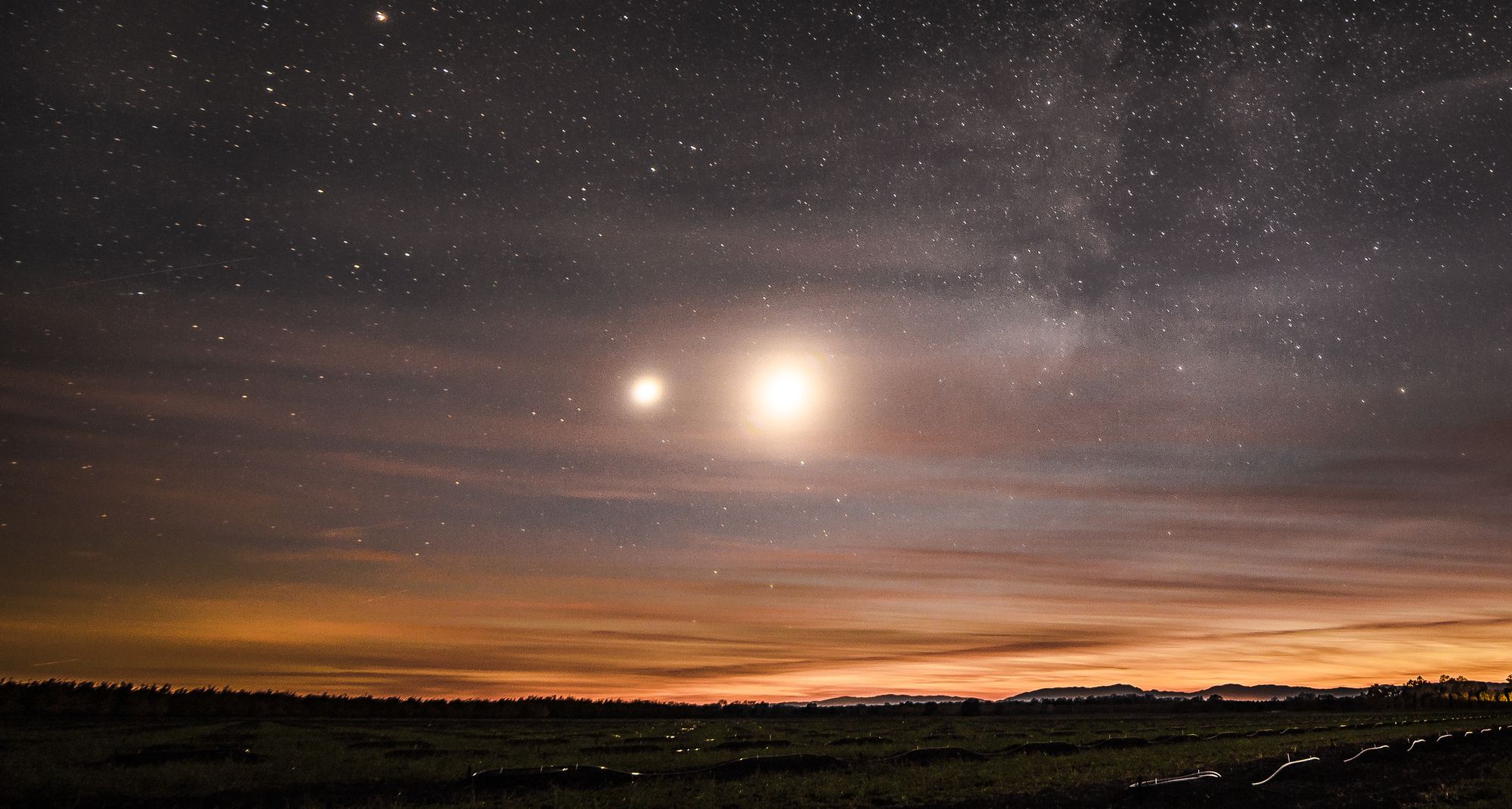
 During 2025, Venus will offer spectacular appearances in the Earth’s sky, alternating between its “evening star” and “morning star” phases.
These phenomena occur when the planet approaches Earth along its orbit, a cyclical event that happens every 19 months and intensifies Venus’s brightness, making it one of the brightest celestial objects visible to the naked eye.
The orbit of Venus and the eight-year cycle
Venus completes an orbit around the Sun in 225 days, while Earth takes 365 days.
These differences create an eight-year cycle, during which Venus appears to repeat a specific path in the Earth’s sky.
During this period, the planet forms a figure similar to a pentagram, a celestial drawing known since ancient times for its regularity.
Being an inner planet relative to Earth, Venus is visible only shortly before dawn or just after sunset.
When it appears in the western sky after sunset, it is called the “evening star”; conversely, when it shines in the eastern sky before dawn, it is known as the “morning star.”
January 2025: maximum elongation and dichotomy
At the beginning of 2025, Venus will still be visible in the western sky as the “evening star,” reaching its maximum eastern elongation on January 10.
On this date, the planet will be high above the horizon after twilight, offering a spectacular view.
A few days later, Venus will reach dichotomy, a particular moment when the planet’s disk appears half-illuminated by the Sun, similar to the first quarter phase of the Moon.
This phenomenon represents an ideal opportunity to observe Venus through a telescope.
Phases and extraordinary brightness
As Venus approaches Earth, the planet will begin to visibly transform.
By February 19, it will show only 23% of its surface illuminated, but its brightness will reach an exceptional magnitude of -4.9, making it a bright beacon in the evening sky.
During this period, the apparent size of Venus’s disk will grow by about 60%, making it an ideal celestial object for telescopic observation.
Celestial conjunctions not to be missed
In 2025, Venus will participate in several spectacular conjunctions with the Moon and other planets:
- January 3: Venus will shine next to a thin crescent Moon just after sunset.
- February 1: Another meeting between a crescent Moon and Venus in the western sky.
- April 24: This time Venus will appear next to the Moon just before dawn, marking the transition to the “morning star” phase.
- September 19: Again before dawn, Venus will be in conjunction with a waning crescent Moon and Regulus, the brightest star in the constellation Leo.
A year of unique observations
2025 represents an extraordinary opportunity to observe Venus in all its phases, from maximum brightness to transforming into a thin crescent.
These events, combined with the spectacular conjunctions with the Moon and other planets, offer astronomy enthusiasts a rich calendar of celestial phenomena to admire and photograph.
 Follow our feed