“`html
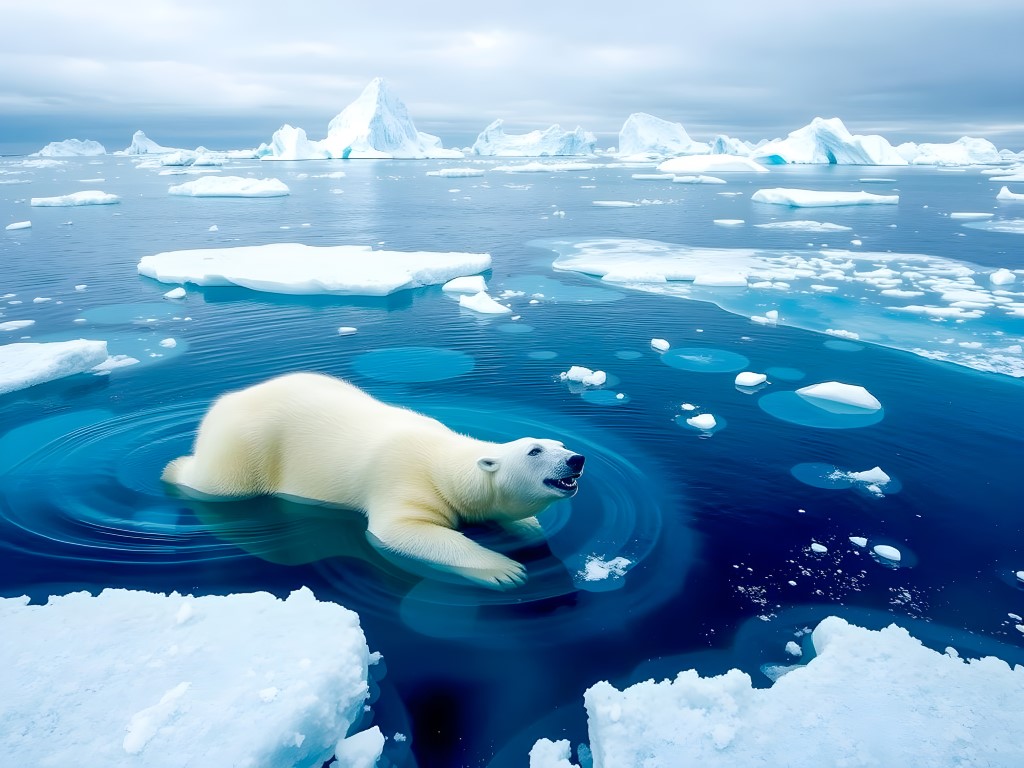
The Arctic of today appears radically different compared to about twenty years ago. Global warming has deeply reshaped its climatic and environmental characteristics, marking an increasingly evident departure from historical conditions.
The increase in temperatures, the accelerated melting of the permafrost, the marked reduction of sea ice, and the alteration of precipitation patterns emerge as unequivocal signs of an ongoing transformation.
These changes are not limited to the mere loss of ice cover but involve the structure of seasonal cycles, precipitation regimes, and the dynamics of the entire Arctic ecosystem.
Humid summer and temperature records
In 2024, the Arctic experienced its most humid summer season ever documented and recorded one of the warmest years in its recent history.
The temperatures of the permafrost, that is, the soil that has been permanently frozen for millennia, reached their second highest values, while the surface of sea ice continues to contract, losing thickness and stability.
These changes, highlighted by the Arctic Report Card published by the NOAA, clearly show an acceleration of warming, which in this region is at least three times faster than the global average.
The Greenland ice sheet is losing tens of billions of tons of ice annually, a phenomenon that contributes to raising sea levels.
This sea level rise is not a problem confined to the Arctic, but it reflects on all the coasts of the planet, threatening urban areas, human settlements, and natural habitats.
The melting of ice and the changing seasons
The loss of sea ice within the Arctic is advancing at an alarming rate, drastically modifying traditional seasonal cycles. In 2024, some areas of Arctic Canada experienced the shortest snowy season in the last 26 years.
The delayed start in autumn and the early melting in spring have altered the delicate balance of ecosystems, affecting the behaviors of animal and plant species that have always relied on the regularity of these cycles.
The alteration of the seasons is not limited to the gradual disappearance of the ice pack but also includes a change in the precipitation regime. These, more humid in summer, have reached extreme values, influencing soils, river basins, and the nutrient cycle.
Consequences for Arctic fauna
The impact of climate change on the fauna of the Arctic is profound and varied. Polar seals, for example, despite facing the decline of the Arctic cod, once their main source of sustenance, have shown a remarkable ability to adapt. They now feed on saffron cod, a species that thrives in less cold waters.
This dietary flexibility indicates an ability to react to new conditions, but not all creatures in the Arctic are equally resilient.
Caribou, emblematic of the northern tundra, are instead undergoing a drastic numerical contraction.
The migratory populations of these animals have collapsed by 65% in the last thirty years, dropping from 5.5 million to 1.8 million individuals. This worrying decline is attributed to events of winter freezing rain, phenomena linked to the warming of temperatures during the coldest months.
The rain, freezing on the plants, forms a crust of ice that prevents the caribou from feeding, leading to significant declines in the species’ survival.
Changes in precipitation and new climate records
Summer precipitation reached record levels in 2024, impacting Arctic ecosystems significantly.
Although some areas saw greater snow accumulation, this was not enough to compensate for the shortening of the snowy season, which has become shorter and more irregular.
The high temperatures, partly responsible for these upheavals, have set new records in various communities in Alaska and Canada, confirming a long-term trend towards an increasingly warm and unstable Arctic.
The implications of such changes are not limited to the natural landscape but extend to local populations. The human communities living in the Arctic, including many of indigenous origin, are forced to rethink their lifestyles.
“`Traditional practices, reconsidering the migratory routes of fauna, and modifying hunting and fishing strategies.
Their cultural and nutritional survival is being tested by a rapidly changing environment.
Global Implications
The profound changes affecting the Arctic are not an isolated phenomenon but a wake-up call for the entire planet.
The amplified warming of the northern region anticipates and amplifies global trends, providing an unequivocal signal of the direction we are heading.
The progressively shrinking ice sheet of Greenland continues to contribute to the rise in sea levels, a reality that affects coastal communities worldwide.
The gradual loss of permafrost, which releases ancient greenhouse gases trapped for millennia, further accelerates climate change.
This dynamic combines with the increasing frequency of wildfires, which release enormous amounts of carbon into the atmosphere, triggering a vicious cycle that is difficult to control.
The Arctic thus serves as a mirror for the health of our planet.
Its evolutions clearly show the damage caused by human actions, indicating the need for coordinated and rapid interventions aimed at limiting the release of greenhouse gases and mitigating the most catastrophic effects of global warming.
The Need for Global Interventions
According to scientists, reversing the course of climate change requires an immediate and substantial reduction in greenhouse gas emissions.
This commitment must involve the entire international community, as the changes recorded in the Arctic have global repercussions.
The challenge is not only technological but also social, economic, and political.
Without collective coordination, the increasing warming and the progressive loss of Arctic ice will continue to alter environmental balances.
The adaptability demonstrated by some species, such as seals, cannot be considered a universal reassurance.
The survival of caribou, a symbol of a millennia-old ecosystem, is seriously compromised.
This reality reflects the need to intervene to safeguard natural environments and human communities, protecting our biological and cultural heritage.
Acting now means preserving the stability of the climate system, curbing the loss of permafrost, and preventing irreversible consequences. It means protecting wetlands, rivers, lakes, forests, and the complex network of relationships that bind plants, animals, and humans. It means containing the impact on agriculture, water resources, food availability, and coastal infrastructure, avoiding further exposure of entire communities to the risks of floods, erosion, and forced migrations.
The fight against global warming involves transforming our energy systems, investing in renewable sources, energy efficiency, and reducing consumption.
It means building ambitious environmental policies, focusing the economy on sustainable models, and protecting ecosystems that provide essential services to life on the planet.
It also means investing in scientific research, technological innovation, and education so that future generations have the tools necessary to face the challenges of climate change with awareness and determination.
Protecting the Arctic represents a crucial test.
It is not just about safeguarding a remote geographical area but preserving a fundamental cog in the Earth’s climate mechanism.
If the Arctic suffers, the entire planet bears the consequences. If, on the other hand, we manage to stabilize the climate, protect the caribou, ensure the survival of indigenous communities, and preserve the delicate balances that govern natural cycles, we can hope for a more stable, resilient, and opportunity-rich future.
The profound transformations taking place in the Arctic are no longer just data in a scientific report but a reality that concerns us closely.
Every additional degree, every extra ton of carbon, every body of water once frozen and now free of ice is clear evidence of the urgency to act.
We must intervene now, through courageous policies, international cooperation, emission reductions, biodiversity protection, and a collective commitment to restore the planet’s thermal balance.
The stakes have never been higher.
Protecting the Arctic means safeguarding our own future. With courageous actions and timely interventions, we can hope to restore harmony between humans and the environment, ensuring the survival of caribou, the resilience of seals, the solidity of permafrost, and the stability of coasts worldwide.
Today’s commitment will determine the quality of life for future generations, allowing those who come after us to inherit a planet still capable of supporting life.
Support life in all its forms.
 Follow our feed