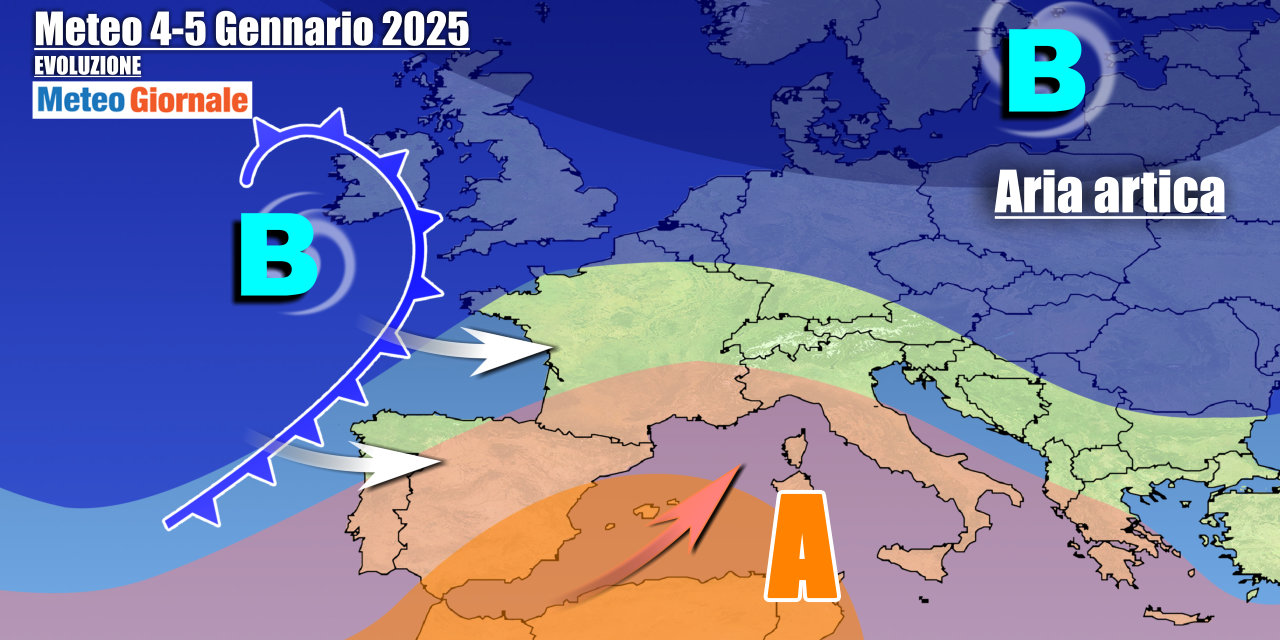
 The forecast models continue to indicate a possible shift towards winter.
For days, weather simulations have been following a consistent line suggesting a clear and imminent climate change, capable of bringing an impressive transformation.
It is likely that, within a week, we will move from the unusually warm temperatures we are experiencing to a sharp and marked drop in temperature. The latest projections from international computing centers outline a well-defined scenario, with atmospheric dynamics already sparking discussions.
The High Pressure, which has dominated the central Mediterranean and brought stability, will retreat westward, rising decisively northward.
This movement will block the passage of Atlantic currents, which have recently traveled the more northern latitudes.
This “block” will open the way for a broad descent of cold air from the Arctic Circle towards the south.
This is the phenomenon known as “meridional exchange,” where warm air masses move north while cold air pours south. The Mediterranean could become one of the main targets of this cold incursion, and if this forecast materializes, we would be facing a very early winter scenario. The expected temperature drop is significant, with a decrease in temperatures that could vary between 10 and 15°C compared to current values.
In practice, autumn would be almost “skipped,” giving way to typically winter conditions. This shift could also favor the formation of a secondary depression over our seas, with the possibility of intense bad weather phenomena.
The sudden drop in temperatures could indeed intensify precipitation, bringing abundant and persistent rains.
However, it is still too early to talk about specific details; the focus at the moment is on confirming the general dynamics, to then more precisely evaluate the implications in terms of rain and temperatures. It is not excluded that this could be just the first of a series of cold impulses.
A further more southern impulse could take advantage of the low pressure that will form over the Mediterranean, further reinforcing the winter scenario.
In this case, the second half of November could fully take on a winter character, confirming a weather trend that some experts had hypothesized for some time. Supporting this hypothesis are some key factors, including the temporary weakening of the Polar Vortex, expected in the coming days.
All these elements seem to converge in a clear direction: there are the premises for a shift towards a colder climate, a shift that could be not only rapid but also lasting.
 Follow our feed