The tropical area of the Pacific continues to remain in a neutral state, but nature is sending us clear signals of the arrival of La Niña.
Meteorologists estimate a 71% probability that La Niña will emerge during the months of September–November, with forecasts indicating its persistence throughout the winter in the northern hemisphere.
According to current data, it is more likely to be a weak La Niña event.

Weather and ENSO phenomena: the heart of forecasts
Meteorologists monitoring the ENSO (El Niño Southern Oscillation) phenomenon rely primarily on two sources: climate prediction models and current conditions observed in the ocean and atmosphere.
Climate models form the basis of forecasts, using updated information on global conditions to produce future simulations.
One of the main models used is the North American Multi-Model Ensemble (NMME), which is a collection of computerized models.
According to these simulations, the arrival of La Niña was predicted as early as last winter, although the development has been slower than expected.
This slowness is not unusual, as forecasts made in spring are often less accurate compared to other times of the year.
However, despite this delay, the models continue to confirm a strengthening of La Niña in the coming months, particularly towards winter.

Ocean temperatures and prediction models
One of the key elements of ENSO forecasts is the surface temperature of the tropical Pacific, particularly in the Niño-3.4 region.
During the month of August, the average temperature in this area was about 0.1°C cooler than the long-term average (1991-2020), but still within the neutral range.
The threshold to define La Niña is an anomaly of at least 0.5°C below the average, so the cooling is happening gradually.
Another fundamental aspect is the role of surface winds, known as trade winds.
These winds, when stronger than normal, contribute to the cooling of the ocean surface, keeping warmer water towards the west of the Pacific.
During the month of August, the trade winds were stronger than average, supporting surface cooling and strengthening the deposit of cold water below the surface, which will emerge in the coming months.
 Weather forecasts for winter 2024

Looking ahead, forecasts continue to indicate a probability greater than 80% that La Niña will manifest by the months of November–January.
A weak event is expected, which means that the impact on global atmospheric circulations will be less pronounced compared to a strong La Niña.
However, even a weak event can influence winter weather in North America, Europe, and other parts of the world.
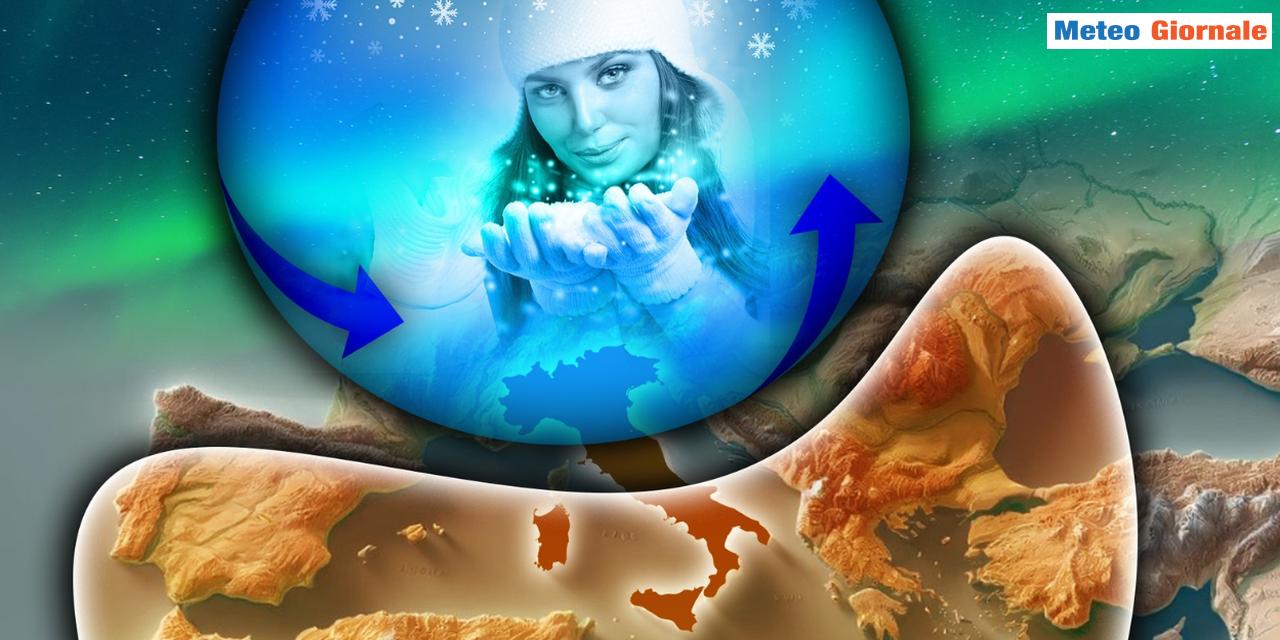
A weak La Niña could result in colder and drier winters in Northern Italy and Central Italy, with the possibility of snowfall below average, but at lower altitudes compared to other years.
Conversely, Southern Italy and the Main Islands like Sicily and Sardinia could experience milder and drier conditions, with less precipitation than normal.
This would be a very serious issue for Sicily, which is affected by a historically significant drought.
Short-term variables and climate change
One of the most complicated aspects of seasonal weather forecasting is short-term variability.
Unpredictable climatic events, such as sudden weakening of the trade winds, can slow down or alter the evolution of phenomena like La Niña.
Although current technology allows for fairly accurate predictions of climate evolution in the coming months, short-term weather variations remain a challenge.
Another influencing factor is global climate change.
Ocean temperatures have been above the global average in recent years, and this could impact the evolution of ENSO.
Although the effects of global warming on ENSO are not yet fully understood, it is likely that they influence seasonal phenomena like La Niña or El Niño.
Conclusion of ENSO forecasts for 2024
although La Niña is delayed, current indicators still support a forecast that will see this phenomenon take hold during the autumn months and persist throughout the winter.
This will impact global weather conditions, with particular attention to temperatures and winter precipitation in many regions, including Italy. Credit www.climate.gov
 Follow our feed