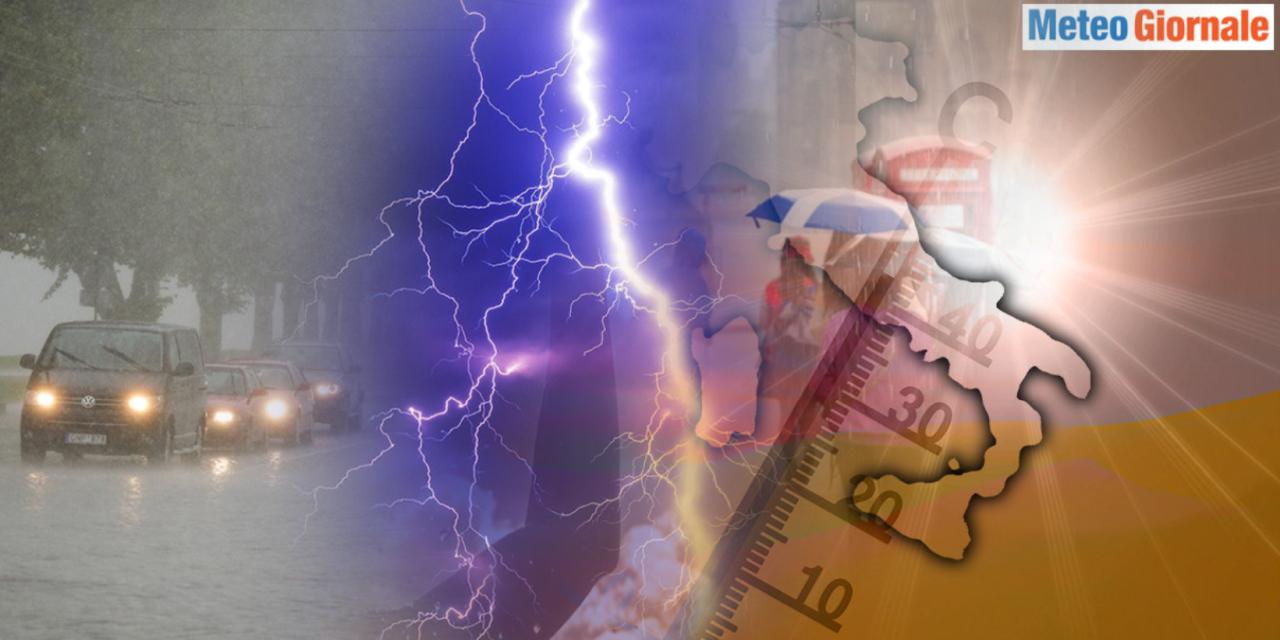
The term water bomb has become popular in common language, especially in the media, to describe meteorological events characterized by violent and sudden rains.
However, those who deal with meteorology consider it inappropriate and misleading, as the term “bomb” evokes an image of an explosion, while the phenomenon it refers to is usually a cloudburst or a flash flood, which are very intense natural processes but completely different in nature from an explosion.
The cloudburst: violent, but not explosive phenomenon
A cloudburst is an extremely intense precipitation that can lead to torrential rains in a short time.
Using the term “bomb” to describe it risks confusing people and not accurately reflecting the meteorological process at play.
It is more correct to talk about a violent cloudburst, flash flood, or even intense thunderstorm, depending on the specific situation. In the case of an event that causes sudden flooding, it is preferable to use the term flash flood, a phenomenon distinguished by its rapidity and devastating effects in a short period of time.
During a flash flood, watercourses overflow quickly, causing extensive flooding that can generate significant damage to infrastructure and homes.
Downburst: let’s not confuse it with a downpour
Another common mistake is the confusion between downburst and downpours.
A downburst is a meteorological phenomenon characterized by a very rapid descent of cold air from the thunderstorm to the ground, causing very violent wind gusts, often exceeding 100 km/h.
This phenomenon can be particularly destructive, causing damage similar to that of a tornado, but without the typical rotation.
A downpour, on the other hand, refers to an intense and sudden rain, but does not involve such powerful winds. People sometimes confuse the downburst with a downpour because both phenomena can occur during a thunderstorm.
However, while a downpour reduces visibility with heavy precipitation, the downburst can cause significant damage especially to buildings and vegetation, without necessarily being accompanied by heavy rains.
Difference between waterspout and tornado
Phenomena such as the waterspout and the tornado are also often misunderstood.
The waterspout is a violently rotating phenomenon that manifests with a dark cone extending from the base of a cloud to the ground.
This type of phenomenon, which is less common in Italy compared to other parts of the world, is sometimes erroneously confused with the downburst or described as an isolated event.
In reality, the waterspout and the tornado are synonyms and refer to phenomena characterized by very high-intensity vortical winds.
The distinction between the two terms is not related to the intensity of the phenomenon, but rather to a matter of language: in Italy the use of “waterspout” is more common, while in other parts of the world, such as the United States, the term tornado is used.
The correct meteorological terminology
Terminological precision is essential to correctly understand and communicate meteorological phenomena.
The use of terms like water bomb may seem effective from a media perspective, but it does not offer a clear and accurate picture of the phenomenon at hand. Talking about cloudbursts, flash floods, downbursts, and waterspouts correctly helps to raise public awareness and promote a more scientific understanding of the weather events that can affect our country. a cloudburst is a phenomenon of violent and sudden rain, but it should not be confused with a “bomb”. A downburst is a wind gust caused by the thunderstorm, while a waterspout or a tornado represent much more violent and complex rotational phenomena.
 Follow our feed