The Winter 2024/2025 could be characterized by particularly interesting climatic conditions, thanks to the influence of various global meteorological phenomena and seasonal predictive indices such as the QBO (Quasi Biennial Oscillation) and the Solar Flux.
These indicators, although they do not offer absolute certainties, can provide a preliminary overview of the possible trends of the cold season, also considering the increasing unpredictability of the climate due to Global Warming. The QBO describes the circulation of stratospheric winds in the equatorial belt, a crucial factor in determining the direction and intensity of winds globally.
When the QBO is negative, there is a higher probability that the prevailing westerly wind circulation will be interrupted, allowing cold continental currents to penetrate southward. In a context of positive QBO, on the other hand, the zonal wind circulation (from West to East) remains more stable, supporting milder climatic conditions in many areas of the northern hemisphere.
The Solar Flux, on the other hand, measures solar activity through the count of sunspots, which represent temporarily cooler regions on the surface of the Sun.
A high number of sunspots indicates high solar activity, which generally translates into a greater flow of thermal energy towards the Earth.
In situations of low solar activity, less energy is received, contributing to colder conditions. For the upcoming winter, forecasts indicate a trend towards a positive QBO associated with high solar activity.
This combination could favor phenomena known as Major Midwinter Warming (MMW), sudden and significant warmings of the polar stratosphere that tend to destabilize the Polar Vortex.
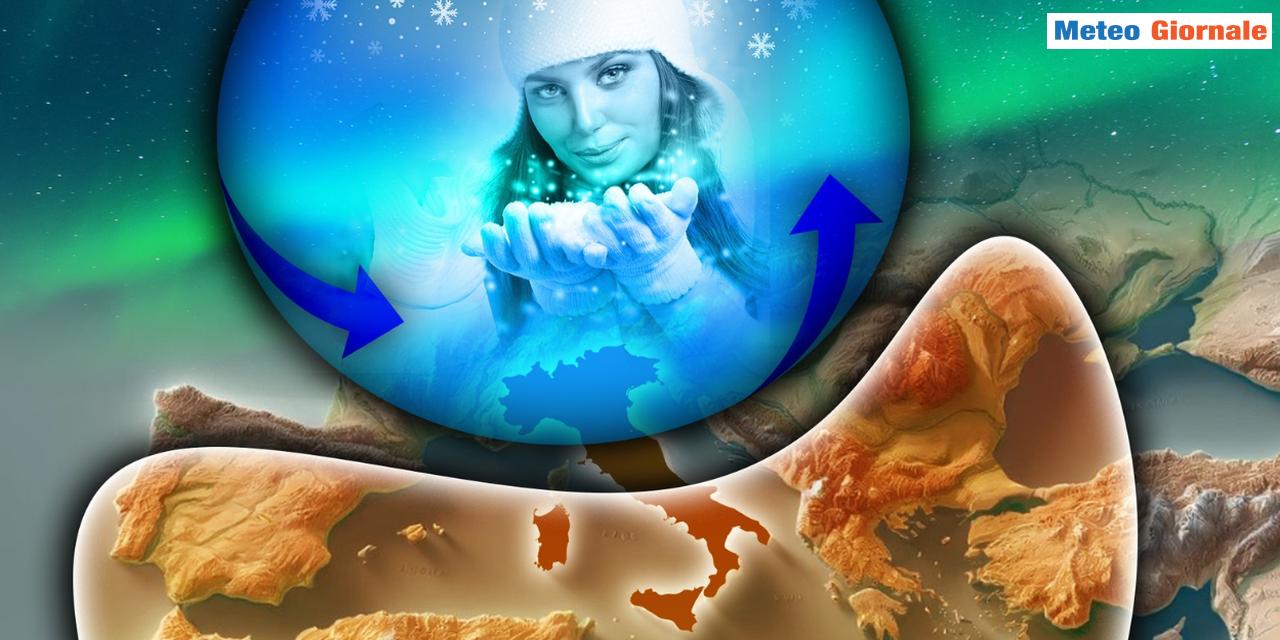
When the Polar Vortex is weak or fragmented, the possibility of intrusions of cold Arctic air towards mid and low latitudes increases, significantly influencing the weather in Europe and the Mediterranean areas.
Another crucial element for winter is the ENSO (El Niño-Southern Oscillation), currently in a phase of possible weak-moderate Nina.
This phenomenon occurs when the surface waters of the Pacific Ocean cool down compared to the norm, influencing global weather patterns.
A weak-moderate Nina could increase the likelihood of periods of intense cold in Europe, as it favors the formation of a more undulating jet stream, which in turn allows the influx of cold air of Arctic origin.
In these cases, the northern and central regions of the continent, such as Scandinavia, Russia, and Eastern Europe, can experience temperatures well below the seasonal average. This configuration can also lead to an increase in snowfall, especially in areas north of the Alps and other mountainous regions.
Even lower altitude areas could see more frequent and abundant snowfalls during a winter influenced by a Nina. Countries like the United Kingdom, Germany, France, and Northern Italy could therefore face significant snow episodes, while the western coasts of Europe could be exposed to winter storms with strong winds, storm surges, and heavy precipitation.
Conversely, Southern Europe and the Mediterranean regions often experience milder climatic conditions during Nina events.
For example, Southern Italy, Greece, and Southern Spain could see slightly above-average seasonal temperatures, with fewer episodes of intense cold.
However, this does not exclude the possibility of bad weather, especially towards the end of winter, with episodes of heavy rain and thunderstorms.
This dichotomy between north and south reflects the complexity of the European climate system and the variety of influences that can interact to determine seasonal weather conditions.
An important aspect to consider is that, despite the general trends suggested by indices such as the QBO, the Solar Flux, and the ENSO, each climatic event is unique and the impacts can vary considerably from year to year.
Other factors, such as the Arctic Oscillation (AO) and the North Atlantic Oscillation (NAO), can interact with the Nina and further modify the climatic patterns in Europe and the Mediterranean.
For example, a negative AO index could amplify the effects of a Nina, further increasing the possibility of intense cold and snow in many regions. Although some models suggest that the Winter 2024/2025 could be colder and snowier than in past years, it is essential to consider the context of Global Warming, which continues to influence long-term climatic trends.
Rising global temperatures can make cold waves less frequent and less intense than in the past, and the influence of climate warming could partially counterbalance the cold effects of a Nina or a negative QBO. the current analysis of predictive indices such as the QBO, the Solar Flux, and the ENSO suggests that the Winter 2024/2025 could be characterized by greater variability and unpredictability compared to recent winters.
The conditions are such as to suggest the possibility of significant cold episodes, especially in the northern and central regions of Europe, with potential abundant snowfalls and extreme meteorological phenomena.
However, the complexity of global climatic interactions makes precise forecasting difficult, and the role of Global Warming adds further uncertainty. Therefore, although there are some promising signs for those hoping for an “old-fashioned” winter, with cold and abundant snow, it is important to maintain a cautious approach.
Climatic indices provide useful indications, but the climate is inherently variable and influenced by a multitude of interconnected factors.
Only time will tell how the Winter 2024/2025 will actually manifest in Italy and throughout Europe.
 Follow our feed